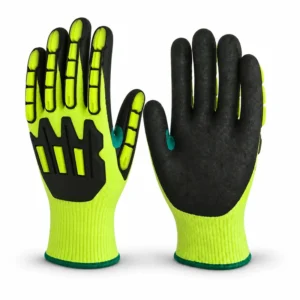
The best cut-resistant gloves are the gloves that match your sharp-edge hazard and still let you control the part, tool or machine safely. A high cut level can be useful, but it does not compensate for poor grip, the wrong coating, exposed wrists, bad sizing or reduced dexterity.
Use this guide after you have completed a task-based hazard assessment. It shows you how to compare cut level, liner, palm coating, gauge, coverage, grip, and wearer feedback before approving a glove for purchasing.
Start with the hazard, not the glove
Describe the object that can cut the hand, the sharpness and condition of its edge, the direction of movement, the force applied and how often the contact occurs. Then record secondary hazards such as oil, water, heat, puncture, impact or chemical exposure.
OSHA requires hand protection to be selected according to the task, workplace conditions, duration of use and identified hazards. This is why one “best” glove cannot cover every cutting job.
Seven factors that determine the best cut-resistant glove
1. The correct cut rating
For North American purchasing, ANSI/ISEA 105-2024 classifies cut performance from A1 to A9. For European purchasing, EN 388:2016+A1:2018 reports ISO 13997 TDM cut performance from A to F. Use the applicable marking and report rather than treating the two scales as direct equivalents.
If you still need to determine a level, begin with our cut-resistant glove level guide.
2. Liner material
HPPE, aramid, steel, glass fibre and engineered yarn blends can produce different combinations of cut performance, weight, softness and durability. Material names alone do not prove a rating. Confirm the complete liner construction and test report for the supplied model.
- HPPE blends: often selected for lightweight comfort and dexterity.
- Aramid blends: often considered when cut resistance and some thermal durability are needed.
- Steel or glass-reinforced yarns: can increase performance but must be engineered to avoid stiffness or fibre discomfort.
- Metal mesh: used for specialised knife and food-processing hazards rather than ordinary coated work gloves.
3. Palm coating
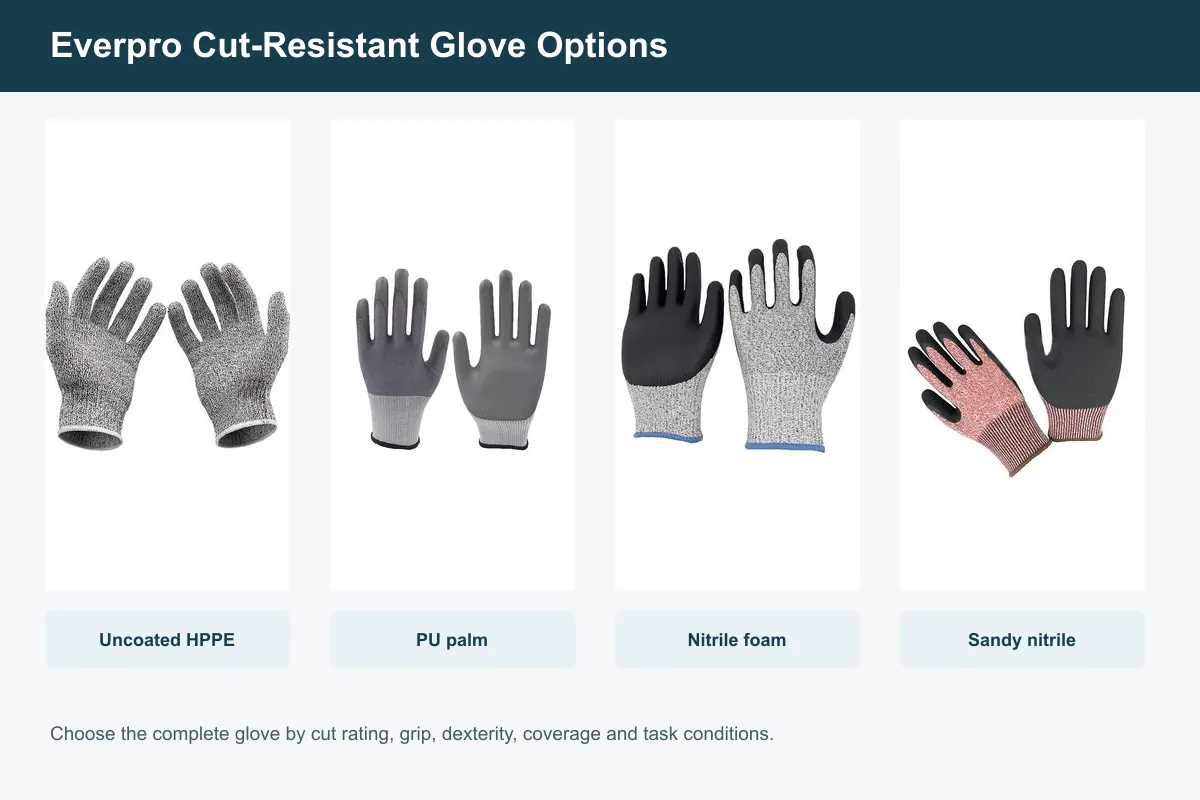
| Coating | Typical selection strength | Points to verify |
|---|---|---|
| PU | Thin coating and tactile control for dry precision work | Abrasion, oil exposure and coating wear |
| Foam or microfoam nitrile | Breathability and grip for dry or lightly oily components | Oil volume, coating permeability and durability |
| Sandy nitrile | Textured grip for oily or wet industrial handling | Dexterity, coating thickness and actual fluid exposure |
| Crinkle latex | Strong dry and wet grip for construction, glass and material handling | Oil compatibility, latex sensitivity and bulk |
| Uncoated knit | Breathability, laundering and some food-handling applications | Grip, liquid absorption and product hygiene requirements |
A palm coating may resist incidental oil or moisture without being a chemical-protective barrier. Select chemical gloves separately when skin exposure is possible.
4. Grip condition
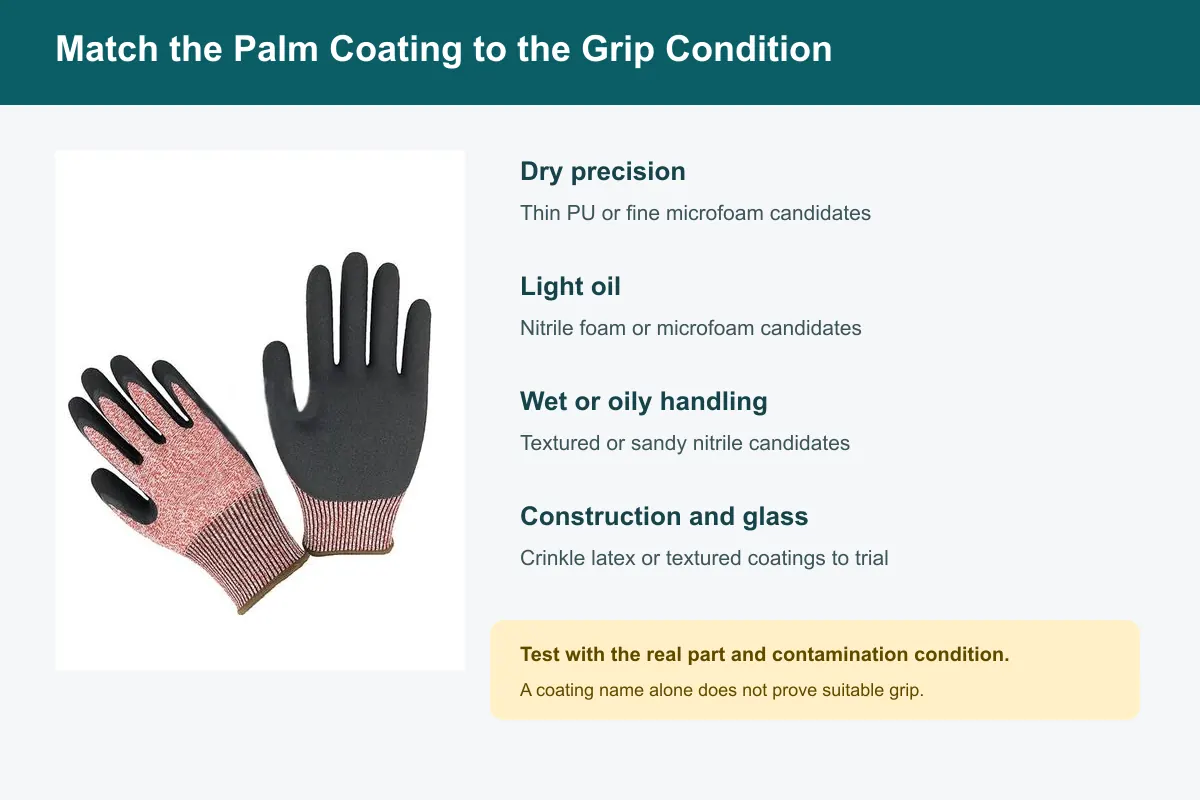
Classify the task as dry, wet, oily, or mixed. Test representative parts rather than relying only on marketing terms. Poor grip can increase hand force, fatigue, and the chance that a part slips toward the edge.
5. Dexterity and gauge
Fine-gauge gloves can improve fingertip control, but gauge alone does not determine protection. Check whether workers can operate fasteners, triggers, touchscreens, and measurement tools without removing the glove.
6. Coverage and reinforcement
Map where injuries or wear occur. The palm rating may not solve exposure at the fingertips, thumb crotch, back of hand, wrist or forearm. Specify reinforced areas and sleeves when the risk extends beyond the glove.
7. Fit and wearer acceptance
A loose glove can snag and shift; a tight glove can limit motion and damage seams. Test the full size range and ask workers about grip, pressure points, heat, sweat and fatigue over a normal work period.
Best glove construction by task
Precision assembly and small parts
Prioritise a close fit, thin PU or microfoam coating and a fine-gauge liner. Select only the cut level required by the edges present. Excess bulk can reduce control of screws, clips and electronic components.
Sheet metal and automotive work
Balance cut level with abrasion resistance and oily grip. Nitrile foam or sandy nitrile may help when components carry light oil. Check thumb-crotch wear and whether sharp sheet edges contact the wrist.
Glass handling
Assess both cut and grip hazards. Crinkle latex or textured nitrile may improve control depending on surface and contamination. Broken glass may introduce puncture and forearm risks that require separate protection.
Construction and material handling
Durability, grip and fit are often as important as the cut rating. Test the glove with timber, metal profiles, masonry products, strapping and tools actually used on site.
Food processing
Confirm food-contact requirements, sanitation method and whether an uncoated, coated or metal-mesh system is appropriate. Knife work needs a different assessment from handling cans, bones or packaging.
Recycling and waste sorting
Hidden edges can combine cut, puncture, contamination and impact hazards. Use a conservative assessment, defined inspection intervals and additional controls rather than relying on a cut level alone.
How to run a useful wearer trial
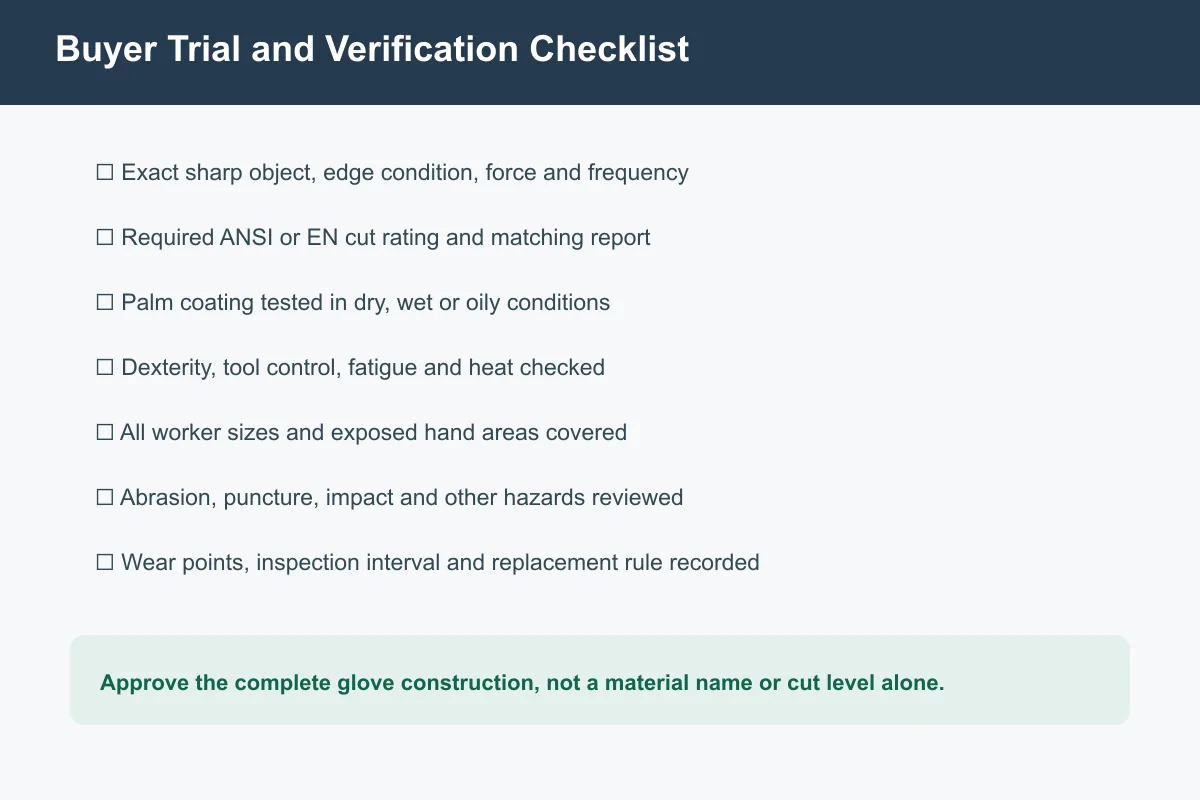
- Select two or three candidate constructions that meet the required standards.
- Include every size needed by the work group.
- Test with representative materials under dry, wet or oily conditions.
- Record grip, dexterity, fatigue, heat, slippage and pressure points.
- Inspect high-wear areas after defined intervals.
- Document why one model was approved and establish replacement criteria.
A trial should not expose workers to uncontrolled hazards. Use safe samples, supervision, and existing engineering controls.
How to compare supplier evidence
- Match the glove model, liner, coating, and size range to the test report.
- Confirm ANSI/ISEA 105-2024 or EN 388:2016+A1:2018 as applicable.
- Review cut, abrasion, and puncture results separately.
- Ask how yarn, coating, and thickness changes are controlled.
- Compare production samples with the approved sample.
- Check packaging marks, user information and declarations required by the destination market.
Common selection mistakes
- Buying the highest cut level without testing dexterity or grip.
- Assuming every HPPE glove performs the same.
- Calling an oil-resistant coating chemical resistant.
- Ignoring puncture, impact, heat, or forearm hazards.
- Approving one glove size for the whole workforce.
- Comparing ANSI and EN levels as direct equivalents.
- Using a test report for a different liner or coating.
Frequently asked questions
What is the best material for cut-resistant gloves?
There is no universal best material. Choose a tested construction that meets the required cut level while providing the grip, dexterity, comfort, and durability needed for your task.
Are thicker gloves more cut resistant?
Not necessarily. Fibre engineering and yarn construction strongly affect performance. Thickness may improve durability but can reduce control.
Which coating is best for oily metal?
Foam, microfoam, or sandy nitrile are common candidates, but oil amount, surface geometry, and required dexterity determine the result. Run a controlled grip trial.
Can cut-resistant gloves stop needles?
Do not assume so. Needlestick resistance requires a separate assessment and relevant testing.
How often should gloves be replaced?
Replace them when yarn, coating, seams, or grip are damaged and according to a task-specific inspection schedule. High abrasion may require replacement before visible holes form.
Build your purchasing specification
State the task, sharp object, cut standard and level, coating, grip condition, liner, gauge, cuff, sizes, secondary hazards, test evidence and trial method. Compare Everpro’s cut-resistant glove range, review the 21-gauge A3 sandy nitrile glove, or contact Everpro Gloves with your application and purchasing requirements.
The following describes several commonly used anti-cutting gloves:
These may not be the best cut-resistant gloves, but they may be the ones you need most.
1. Cut-101

These anti-cut gloves are made from an HPPE special type of fibre. It is a combination of glass, PE silk, spandex and polyester fibre for the most comfortable fit minus the odour. It is food-grade, which means it can be used for food processing in addition to other industries.
Pros:
- This material, although flexible and dexterous, is highly resistant to cuts. In fact, it is up to 4 times stronger than that of leather even though it is thinner.
- The grip is excellent. It can fit different sizes of hands without impeding hand movement, great for more intricate tasks like food preparation.
- It doesn’t feel heavy. You can work on various tasks without feeling tired.
- Because of the flexible materials, you can machine-wash these gloves.
Cons:
- These gloves are not ideal for heavy-duty activities but more suitable for kitchen and food processing tasks. If you are using it for tougher applications, it might not be the best choice.
Best cut resistant gloves–food grade, click here to find it.
2. Cut-201

We consider these anti-cut gloves all-around gloves because they can be used for a variety of purposes such as in auto repair, logistics, construction, hardware and many other industries that require more durable and wear-resistant gloves. It has the same HPPE liner as the previous one but has a PU coating.
Pros:
- What is great about this is that it seems to strike a good balance between hand dexterity, cut protection and liner comfort. It feels ergonomic and has a good stretch to it, which makes way for better and more natural hand movements.
- It can protect your hands from cuts but it is also thin enough that it still offers tactile benefits.
- It offers a good amount of protection to slightly oily environments. You can put it in the washer if it needs to be cleaned. The material is durable enough to withstand more rigorous applications.
Cons:
- These gloves are not the most breathable, so they might be a tad uncomfortable to use in the summer.
When you want to know more about purchasing this glove, you can click here.
3. Cut-301

These anti-cut gloves boast a liner made from Spun Yarn or HPPE materials and have a latex crinkle coating. You can use these gloves for a variety of purposes and applications such as construction, automotive repair, logistics and glass handling.
Pros:
- These latex gloves have the best grip. It is due to the fact that it has latex crinkle coating. This is what prevents objects from slipping off of your hands, so if you need superior grip, get this one.
- The coating really does a good job in protecting the hands from cuts. It is also more resistant to abrasions, tears and punctures.
- It still provides excellent tactile sensitivity and flexibility. You can still move your hands easily when picking up objects.
- They actually feel more comfortable than similar gloves made from leather materials. You can wear them for an extended period of time and not feel hand fatigue or not experience sweating in your hands.
Cons:
- You might need to size up because the fit can be quite tight.
Maybe this glove is your best cut-resistant gloves, click here to learn more.
4. Cut-1101

These are the anti-cut gloves to look for if you are looking for a coating of nitrile foam and you want the liner to be made from HPPE material. It is suitable to be used for a variety of applications including construction, tool handling, automotive repair, security, hardware and many more.
Pros:
- These gloves are not just puncture and cut resistant, they are also comfortable to use. They are ergonomic and they fit the hands really well, as if you have a second skin. They also feel lightweight, great for usage for extended periods of time.
- These gloves are suitable even when handing slightly oily or moist substances. They still have excellent grip.
- These gloves are really good when using it in the summer because they are breathable.
- You can still operate your smartphone even with these gloves on.
Cons:
- These gloves do emit a chemical smell, which can linger on your hands for a while.
When you want to know more about purchasing this glove, you can click here.
5. Cut-801

These anti-cut gloves are much like the previous ones in the sense that they can be used for a variety of purposes. They feature a liner made from Spun Yarn or HPPE materials and a coating of Nitrile Micro-Foam.
Pros:
- If you are looking for the best breathability, these are the gloves you should look for. They are comfortable to wear all day as they allow air to seep in different directions.
- These are truly cut-resistant. The forefinger and the thumb area are even reinforced as these are the areas of the hands that are usually more prone to cuts.
- They don’t interfere with what you are working on, so you can do more intricate jobs as well. The fit is a bit more on the snug side, which means it feels more like a second skin. It almost doesn’t feel like you are wearing gloves.
Cons:
- These gloves do hold up well but not so much when it comes to heavy duty applications.
6. Cut-601

These anti-cut gloves have the same Spun Yarn PE or HPPE liner material as the previous gloves but have latex sandy coating that will make them suitable for use in various industries like glass fabrication, auto repair and construction.
Pros:
- The knitted fibers of these gloves make them more resistant to cuts and abrasions. If you need excellent hand protection, you will these. They help protect your hands from sharp materials.
- The sandy finish offers excellent grip. You can hold even slippery objects like metal and glass with ease. It is also resistant to oily materials.
- They can last for a long time with some care and attention. They don’t get easily grimy easily as well.
Cons:
- The base part where the index and middle fingers meet tend to be too tight and have a pinched feel to it.
7. Cut-901 (one of the best cut-resistant gloves recommended)

These cut-resistant gloves are great for all-around cut-resistant gloves as it has a coating of sandy and nitrile smooth. This is a great alternative for those who don’t like latex materials.
Pros:
- When it comes to cut resistance, these gloves won’t fail you. It offers maximum protection against cuts and abrasions, so you can work without worrying that you will subject your hands to damages.
- Th wrinkled surface provides a good amount of grip. This makes it easier to work on slippery materials like glass or metals effectively.
- The nitrile coating prevents moisture from seeping inside the gloves, giving your hands more protection from external elements. If you handle products or materials that are wet, you can use these gloves to protect your hands.
- These gloves feel secure. The wrist area feels secure but not too tight that you feel like your hands are constricted. They are also easy to put on and take off when needed.
Cons:
- They won’t provide you with excellent insulation, so if you are expecting them to keep your hands warm when dealing with water, you might be disappointed.
8. Cut-201A

You can rely on these gloves for all sorts of needs such as repairing your car, handling tools, hauling stuff and many more. With its PU coating and HPPE lining, it offers a good level of protection against cuts and abrasions.
Pros:
- The materials used are truly resistant to cuts and punctures. But even though they provide excellent protection, these gloves are still thin enough to have good dexterity. You can still feel what you are working on, so it doesn’t take away the tactile feel. You can pick up small objects like screws, nuts and bolts.
- These are very affordable gloves, so if you are on a budget and you need to buy work gloves in bulk, you will find these ideal.
- They are easy to wear and do not weigh too much. You can wear them all day without feeling tired.
Cons:
- These gloves are not to be abused. When used for heavy-duty applications, they might not hold up well.
9. Cut-401

Breathable and strong, these anti-cut gloves have a Spun Yarn PE or HPPE liner and are coated with a latex sandy coating. It’s an excellent choice if you are looking for an all-around pair of gloves that will not make your hands sweaty.
Pros:
- The fiber construction of these gloves makes them effective when it comes to protecting your hands against abrasions and cuts.
- The sandy coating increases grip. You can grab slippery tools and small objects without worrying that they will fall.
- Handling materials and tools is still easy even with these gloves on. Having said that, you can do a variety of tasks in the kitchen and in the workshop with these gloves on.
Cons:
- These gloves might not offer the best fit.
10. Cut-701 (one of the best cut-resistant gloves recommended)

For those looking for more thumb protection, get this one. It features Nitrile sandy coating and has a reinforced thumb for better protection from cuts and abrasions.
Pros:
- The exterior material feels smooth and the fingertips can hold objects well without compromising its protection. They do have the “second skin” feel.
- These have an amazing fit. They even work for people with large hands.
- These are free from materials that cause allergies.
Cons:
- There aren’t a lot of bad reviews about this product.