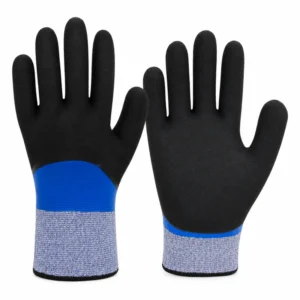
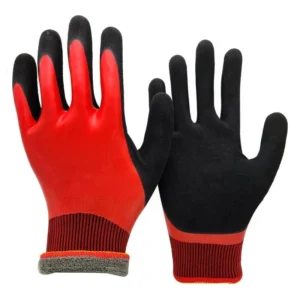
Short answer: work glove gauge describes the fineness of the knitted liner. A higher number generally means a finer, closer-fitting liner: 13-gauge gloves often feel more substantial, 15-gauge gloves balance support and dexterity, and 18- or 21-gauge gloves can improve fingertip control for precision tasks. Gauge is not a safety rating, however. It does not tell you the cut level, coating thickness, grip, liquid resistance, or service life.
You should use gauge to narrow the required feel and fit, then compare yarn, coating, coverage, size, and verified performance for the actual task. This guide helps buyers and workers compare common gauges without assuming that thinner is always better.
What does gauge mean in work gloves?
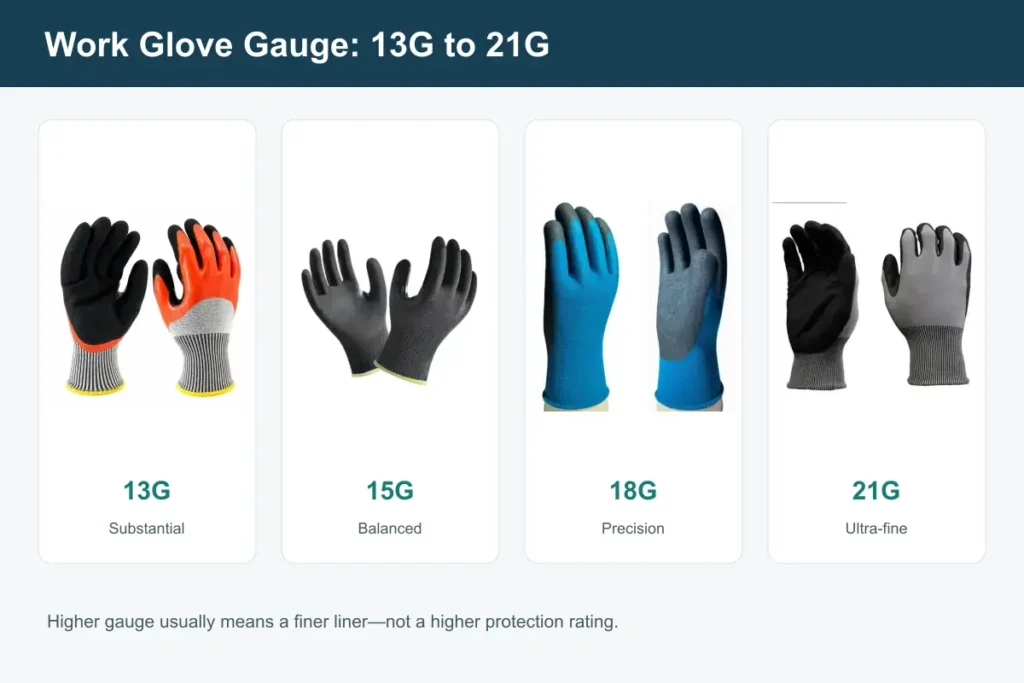
Gauge commonly refers to the needle density of the knitting machine used to make a seamless glove liner. Higher-gauge machines use more, finer needles across the knitting width and normally require finer yarn. The resulting liner can feel thinner, smoother, and closer to the hand. Lower-gauge machines normally work with coarser yarn and produce a heavier-feeling shell.
Gauge is only one construction variable. Two 18-gauge gloves can feel different because of yarn type, fibre blend, stretch, knitting tension, coating formulation, and finished glove shape. You should therefore compare physical samples rather than converting gauge into an assumed millimetre thickness.
What if you see 10G? It is a coarser-knit option found in some heavy-duty glove ranges. Treat it as a construction description, not a protection grade. Compare the exact liner, coating, finished fit, and test results; this guide focuses on the 13G–21G options buyers commonly compare for industrial handling and precision work.
13G vs 15G vs 18G vs 21G: a task-based comparison
| Gauge | Typical feel | Where it may fit | Purchasing check |
|---|---|---|---|
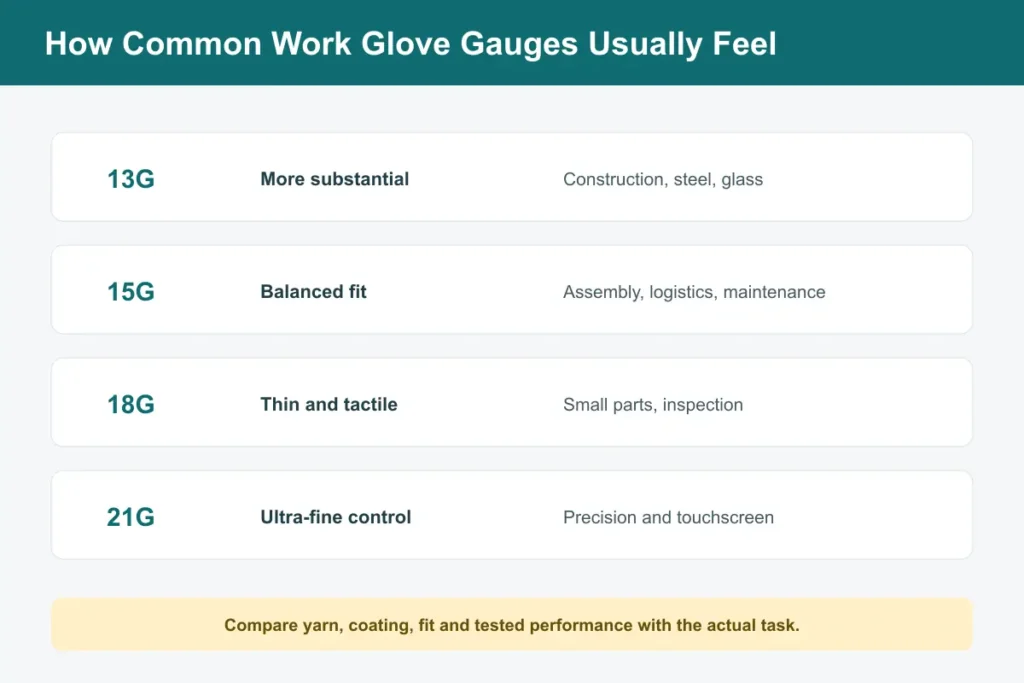
| 13G | More substantial and supportive | Construction materials, steel handling, glass, general maintenance, and higher-demand cut-resistant designs | Check bulk, finger flexion, yarn, and protection rating |
| 15G | Balanced fit, flexibility and durability | Automotive assembly, logistics, maintenance, gardening and repeated parts handling | Compare coating thickness, thumb wear and all-shift comfort |
| 18G | Thin, close-fitting and tactile | Small parts, inspection, electronics, light metal handling and precision assembly | Verify snag resistance, coating consistency and required protection |
| 21G | Ultra-fine, light and highly flexible | Very small components, touchscreen use, quality inspection and precision work needing cut protection | Confirm yarn durability, fit, protection level and task suitability |
How to choose a glove gauge for your task
13-gauge gloves: support for demanding handling
A 13G liner is a common choice when you need a more substantial shell or when protective yarns and reinforcement are part of the design. It can suit steel, sheet metal, glass, construction material, and maintenance tasks, provided the finished glove carries the required tested protection.
Do not assume every 13G glove is heavy duty. A 13G polyester general-purpose glove and a 13G HPPE composite cut-resistant glove can have very different capabilities. Everpro’s CUT-402 13G ANSI A4 glove illustrates a protective composite liner with double nitrile coating.
15-gauge gloves: a versatile middle option
Fifteen-gauge liners often provide a close fit without moving fully into an ultra-thin construction. You may consider them for automotive assembly, logistics, tool handling, gardening, maintenance, and other repetitive tasks where workers need both support and hand movement.
The coating can dominate the experience. A thin microfoam palm coating can preserve tactility, while a full or thick coating can make the same liner feel warmer and less flexible. See Everpro’s PT-N101 15G microfoam nitrile glove as one precision-handling example.
18-gauge gloves: precision with industrial capability
An 18G liner can sit closely around the fingers and help workers handle fasteners, components, scanners and inspection tools. Common applications include automotive assembly, electronics, warehouse picking, light metal handling and quality control.
Thin does not mean unprotected. Modern engineered fibres can support tested cut resistance in fine-gauge constructions, but the rating belongs to the complete tested glove. Everpro offers both the PT-N601 18G sandy nitrile glove for general precision handling and the CUT-202 18G ANSI A4 glove for tasks requiring verified cut protection.
21-gauge gloves: ultra-fine control
A 21G liner is designed for a very fine, flexible fit. It may help with tiny parts, touchscreen work, inspection, and controlled handling where workers frequently remove bulkier gloves. The finer construction still needs enough durability and the right coating for the work surface.
The CUT-1601 21G ANSI A3 glove combines a fine composite liner with sandy nitrile palm coating. Its 21G construction does not create the A3 rating by itself; the tested yarn, knit, and complete glove construction do.
What glove gauge does not tell you
Gauge is not cut resistance
A 13G glove is not automatically more cut resistant than a 21G glove. Cut performance depends on fibres, reinforcements, knit, and the tested finished construction. Check the exact ANSI/ISEA or EN 388 result for the supplied model.
Gauge is not coating thickness
Gauge describes the liner, while the coating is a separate layer. Palm dip, full dip, sandy nitrile, microfoam nitrile, latex, and PU can change thickness, grip, and flexibility. Use our glove coating coverage guide to compare coverage separately.
Gauge is not abrasion or puncture performance
Fine liners can use strong yarns, and coarse liners can use basic yarns. Abrasion and puncture performance must be confirmed from applicable test results and the way the actual workpiece contacts the glove.
Gauge is not warmth
Cold protection depends on insulation, liner layers, air retention, moisture and coating—not simply knit gauge. A low-gauge shell may feel thicker, but that alone does not establish a cold rating.
Match glove gauge to industry and handling task
Construction and gardening
When handling blocks, timber, stone, soil and tools, assess abrasion, puncture, grip and moisture before deciding whether a substantial 13G or flexible 15G liner is preferable. Thorn and nail risks require separate puncture consideration.
Oilfield, mining and steel
Heavy parts, sharp edges, oil and impact may require cut-resistant yarns, textured grip and back-of-hand impact protection. Gauge affects feel, but it should follow the hazard assessment rather than replace it.
Glass and sheet metal
You may need both fingertip control and tested cut protection. Compare 13G, 18G and 21G samples with the real edge, weight and handling method. Add forearm protection when exposure extends beyond the glove.
Assembly, logistics and inspection
For small fasteners, scanners and repeated picking, 15G, 18G or 21G may improve control. Test whether the finer liner survives snagging and abrasion during the expected replacement interval.
Hot work and thermal processing
Do not select a glove for heat exposure based on knit gauge. Thermal gloves require suitable heat-resistant materials, construction, and verified performance for the contact, convective, or radiant heat hazard.
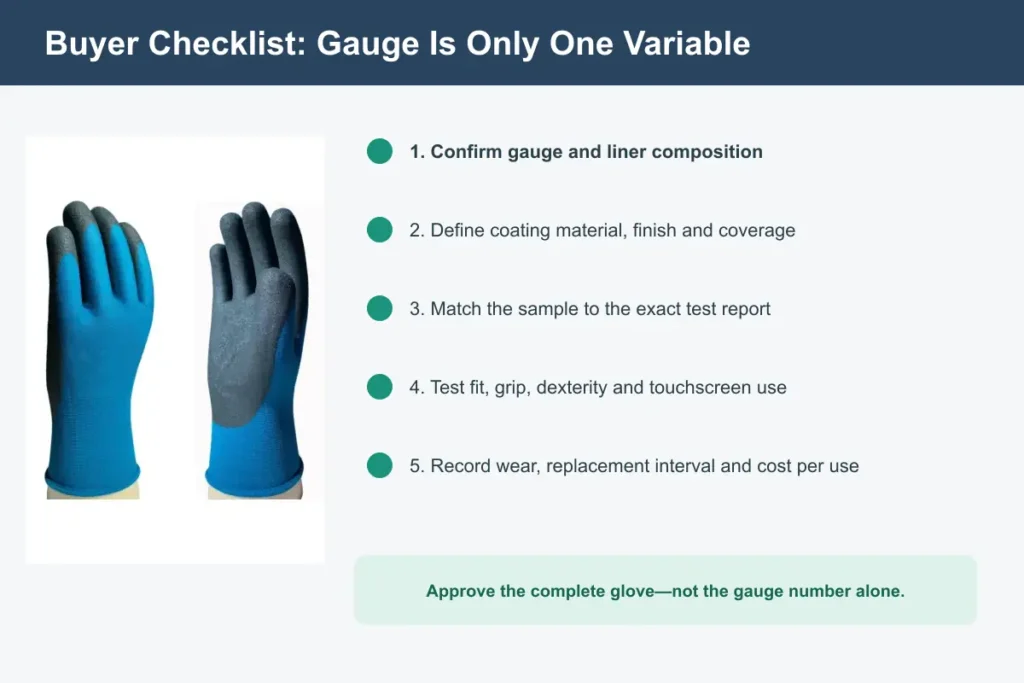
A buyer’s sample-comparison checklist
- Confirm the stated gauge and liner composition.
- Verify coating material, finish, and coverage.
- Match the exact sample to its test report and marking.
- Check finger length, palm width and size consistency.
- Test pinch grip, power grip, tool control, and touchscreen use where relevant.
- Run trials with dry, wet, or oily representative parts.
- Inspect fingertips, thumb crotch, coating edge, and seams after defined cycles.
- Record worker feedback, replacement interval, and cost per use.
OSHA’s 29 CFR 1910.138 hand protection rule requires selection to reflect the task, conditions, duration of use, and identified hazards. Gauge can support that comparison, but it cannot replace hazard-based glove selection.
What to include in your RFQ
- Task, industry, and handled material.
- Liner gauge, yarn, and required size range.
- Coating material, finish and coverage.
- Required cut, abrasion, puncture, impact, cold or heat performance.
- Dry, wet, oily or contaminated grip condition.
- Touchscreen, reinforcement, cuff and color requirements.
- Test documents, approved sample, and inspection criteria.
- Quantity, logo, label, packaging and destination.
Browse Everpro’s nitrile-coated gloves and cut-resistant gloves, or send your task and specification to Everpro for sample review.
Frequently asked questions
Is 18 gauge thinner than 13 gauge?
Generally yes, because 18G uses a finer knitting system and yarn. Finished thickness still depends on yarn, tension, coating, and glove design.
Does a higher gauge mean better gloves?
No. A higher gauge usually means a finer liner, not higher protection or quality. The best gauge is the one that supports the task while meeting all required performance.
What gauge is best for construction?
There is no single answer. Many handling tasks may suit 13G or 15G, while detailed installation may benefit from 18G. Cut, puncture, impact, and grip risks determine the final glove.
What gauge is best for glass handling?
Choose by the glass edge, weight, grip condition, and cut rating. Fine 18G or 21G designs may improve control, while some heavy glass tasks need a more substantial construction and arm coverage.
Can 21-gauge gloves be cut resistant?
Yes. Fine engineered yarns can achieve tested cut resistance, but you must verify the specific finished glove rating.
Does glove gauge determine coating coverage?
No. Gauge describes the knitted liner. Palm, 3/4, full, and double coating are separate construction choices.
What does 10 gauge mean in work gloves?
10G describes a coarser knitted liner than 13G or 18G. It does not tell you the glove’s protection rating, coating thickness, or suitability for a particular hazard.