
Short answer: choose palm-dipped gloves when breathability and dexterity are your priorities; consider 3/4-dipped gloves when you need more side and back-of-hand coverage; use fully coated gloves when dirt, moisture, or oil may reach most of the hand; and specify double-dipped gloves when a separate base layer and grip layer are required. These terms describe different things, so confirm the coating diagram, sample, and intended exposure before ordering.
This guide helps you compare glove coating coverage for industrial purchasing. It also explains why “full dip” does not automatically mean waterproof and why “double dip” does not tell you which parts of the glove are coated.
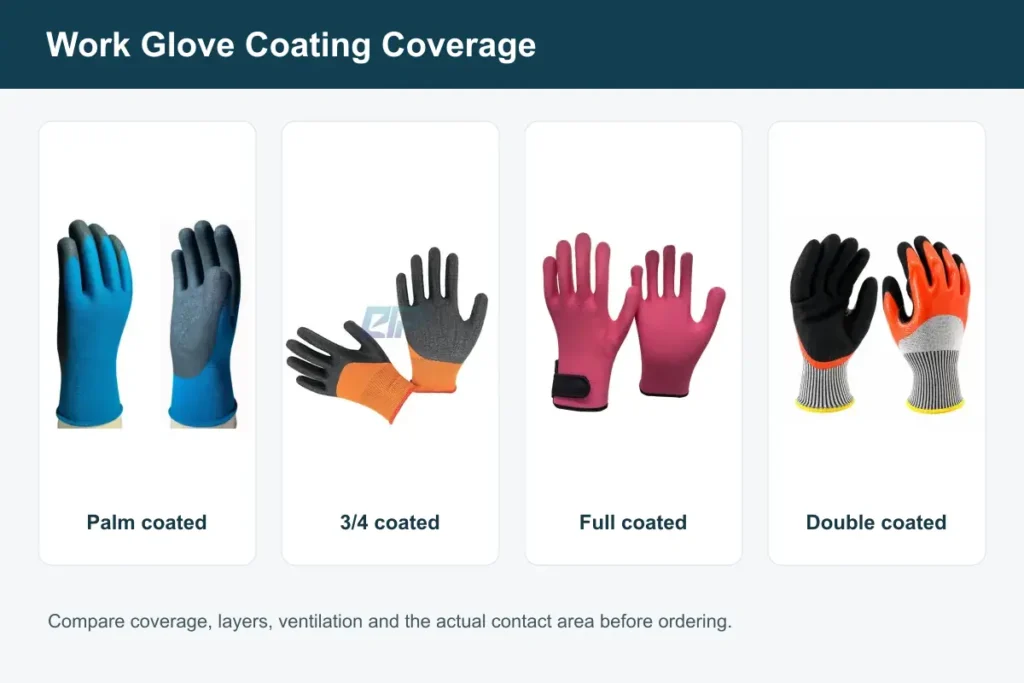
Coating coverage and coating layers are not the same
Coverage tells you where the coating reaches: the palm, fingers, sides, back of the hand or nearly the entire knitted shell. Layers tell you how many coating applications are used. A glove can therefore be fully coated with one layer, or double coated with a full base layer plus a second palm grip layer.
Supplier terminology is not always consistent. “Palm dip” and “half dip” may be used for similar products, while one factory’s 3/4 dip line may reach higher or lower on the back than another’s. For a purchase specification, include photos or a coverage drawing instead of relying on the name alone.
Quick comparison of coating coverage
| Construction | Typical coverage | Main advantage | Main limitation | Common applications |
|---|---|---|---|---|
| Palm dip/palm coated | Palm and working side of fingers; knitted back remains exposed | Breathability, flexibility and lower weight | Limited barrier on the back and around the coating edge | Assembly, logistics, dry handling, inspection and tool use |
| 3/4 dip | Palm, fingers, sides and part of the back | More splash and abrasion coverage while retaining some ventilation | Uncoated areas can still admit liquid and contamination | Construction materials, refuse handling, damp components and maintenance |
| Full dip / fully coated | Palm, fingers and back of the hand; cuff opening usually remains unsealed | Broader contact coverage against dirt, moisture and oil on coated areas | Less ventilation; coverage alone does not prove waterproof or chemical resistance | Wet handling, oily parts, cleaning, gardening and general maintenance |
| Double dip / double coated | Two coating applications; coverage depends on the design | A base layer can provide coverage while a second textured layer improves grip or wear life | Can add weight, stiffness and heat; the first and second dip areas must be specified | Wet or oily work, winter handling, cut-resistant industrial work and heavy material handling |
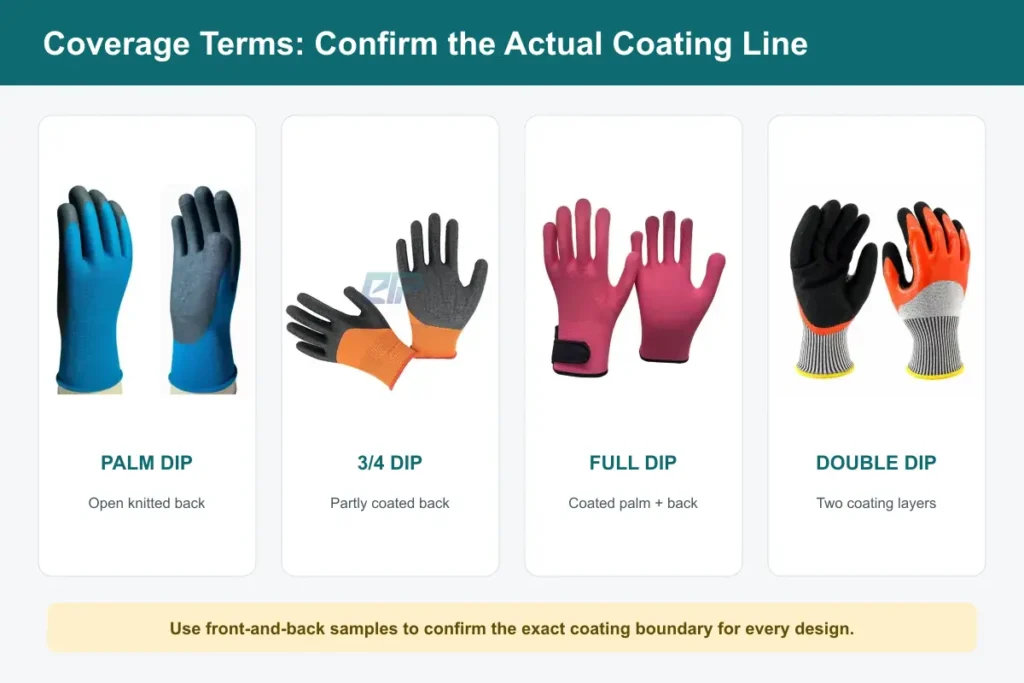
Palm-dipped gloves: best when ventilation and control matter
Palm-dipped gloves leave most of the knitted back open. This helps heat and moisture escape and usually preserves a light, flexible feel. You may prefer this construction for repetitive picking, assembly, warehouse scanning, and handling dry or lightly oily parts.
The exposed knit is also the limitation. A palm-coated glove should not be selected when liquid regularly reaches the back of the hand or when the glove is expected to act as a broad contamination barrier. For a thin precision option, review Everpro’s 18-gauge sandy nitrile palm-coated glove.
3/4-dipped gloves: a middle level of coverage
A 3/4-dipped glove extends coating beyond the palm to the fingers, sides, and part of the back. It can protect more of the knitted shell from abrasion, grime, and incidental splash while leaving an area open for ventilation.
Because the coating line varies by tooling and process, ask your supplier to mark the front, back, thumb crotch, and wrist coverage on a drawing. Inspect several preproduction samples in every ordered size; the coating boundary should be consistent and should not restrict finger flexion. Everpro’s PT-L1001 crinkle latex glove provides a 3/4-coated product example.
Fully coated gloves: broader coverage, with important limits
Fully coated gloves cover the palm, fingers, and back of the hand. This can help keep oil, water, and dirt away from the covered knit during incidental contact. It also reduces airflow and can increase drying time after extended wear.
Fully coated does not automatically mean waterproof. Water resistance depends on coating continuity, pinholes, seams, cuff design, material formulation, and test conditions. The wrist opening normally remains open. Likewise, full coverage is not evidence that a glove is suitable for chemical immersion. Chemical selection requires the exact substance, concentration, temperature, contact duration, and compatible test data.
See the PT-N202 fully dipped foam nitrile glove for a single-layer full-coating example.
Double-dipped gloves: specify both layers
Double dipping means the glove passes through two coating applications. It does not describe one universal construction. A common design uses a smooth full or 3/4 base coat and a textured palm coat. The base layer increases coverage, while the second layer can add grip and abrasion resistance at the working surface.
For example, Everpro’s CUT-402 uses a smooth nitrile first coat with a sandy nitrile palm finish. The WT-L701 winter glove uses a full-hand latex base coating plus an additional textured latex palm and finger layer.
Your specification should state the material, texture, and coverage of each layer separately. “Double nitrile” or “double latex” without a diagram is incomplete.
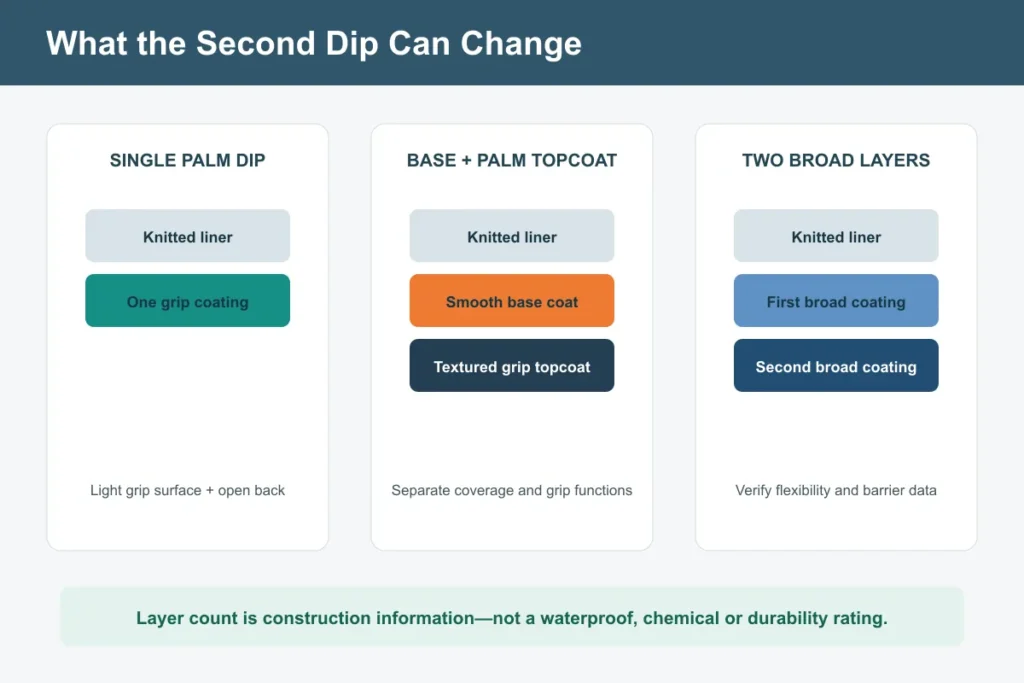
What the second coating can actually change
A second coating can perform several different jobs: extend liquid coverage, close more of the knitted surface, place a textured grip finish on the palm, or add wear material to a high-contact area. It may use the same polymer as the first layer while using a different formulation or surface finish.
| Layer sequence | What it is designed to do | What you still need to verify |
|---|---|---|
| Single palm dip | Provide a light gripping and abrasion surface while leaving the back open | Grip condition, coating boundary and wear life |
| Base coat plus textured palm topcoat | Separate broader contact coverage from the working grip surface | Base continuity, topcoat adhesion, stiffness and oily grip |
| Two broad or full coating layers | Build a more substantial coating system across most of the hand | Pinholes, cuff entry, flexibility and product-specific liquid or chemical data |
Two dips do not mean twice the service life. Durability also depends on compound abrasion resistance, film thickness, adhesion between layers, flex cracking, contaminants, and the location of contact. Compare the finished glove’s applicable test results and field-trial wear pattern rather than counting layers.
How coverage changes glove performance
Breathability and heat
More exposed knit usually improves ventilation. More coating usually reduces airflow and can increase heat and perspiration. Liner gauge, yarn, and coating formulation also affect comfort, so compare complete samples rather than coverage alone.
Liquid and contamination contact
Higher coverage can reduce incidental contact on coated areas. It does not create a sealed system at the cuff, and defects or wear can break the barrier. If liquid contact is central to the task, request the appropriate test data and conduct a representative trial.
Grip
Grip depends mainly on coating material, surface finish, contamination, and the handled object. A second sandy, foam or crinkle palm layer can improve traction, but the result must be tested with your real tools, parts and liquids.
Abrasion and service life
Coating can protect the knit from rubbing and grime, while an extra palm layer may extend wear in high-contact areas. Greater thickness is not automatically longer-lasting if the coating cracks, delaminates, or becomes too stiff for the task.
Dexterity and fatigue
Added coverage and layers may increase stiffness and grip force. Check pinch grip, fastener handling, tool control, and fatigue through a normal work cycle. Approve all required sizes, because coating tension can feel different across the size range.
A five-step purchasing process
- Map the exposure: identify where oil, water, dirt, and abrasion contact the palm, fingers, sides, and back of the hand.
- Choose minimum useful coverage: select enough coating for the mapped exposure without adding unnecessary heat or stiffness.
- Define every layer: record coating material, finish, color, coverage and expected function for the first and second layers.
- Verify documents and samples: match test reports and product markings to the exact liner, coating, and construction supplied.
- Run a field trial: test grip, liquid contact, dexterity, heat, wear, and cleaning with representative workers and parts.
OSHA’s hand protection rule, 29 CFR 1910.138, requires glove selection to reflect the task, conditions, duration of use, and identified hazards. A coverage label by itself is therefore not a complete selection method.
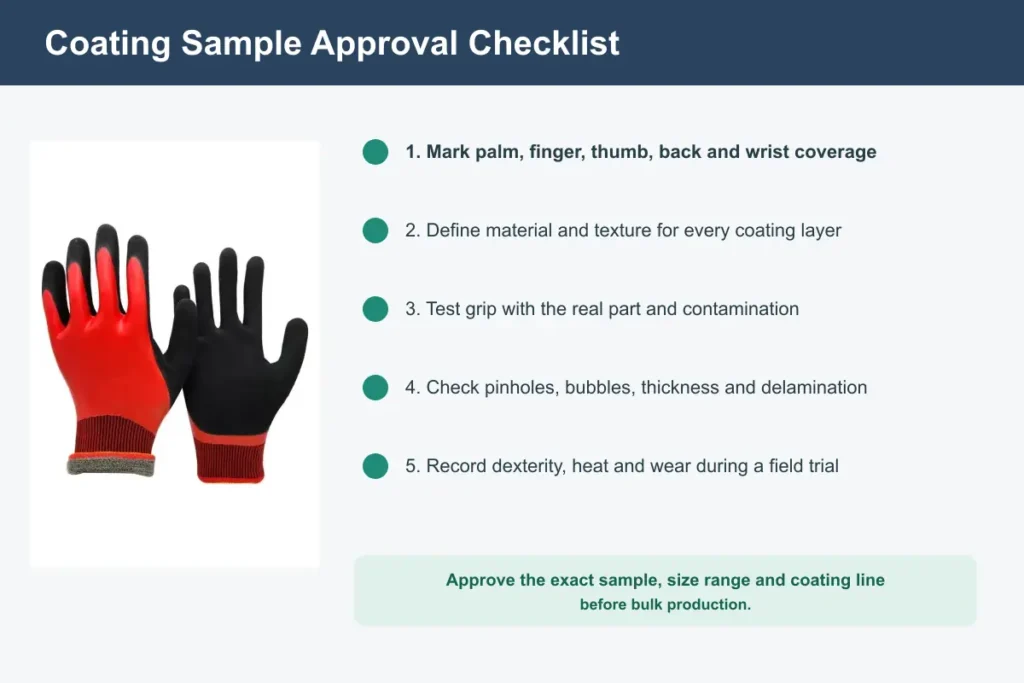
What to include in an RFQ or specification sheet
- Application, handled material, and dry, wet, or oily condition.
- Liner material, gauge, size range, and cuff style.
- Coating material and surface finish.
- Coverage on the palm, fingers, thumb, back, and wrist.
- First- and second-layer details for double-dipped designs.
- Required mechanical, cold, or chemical performance and applicable test reports.
- Color, logo, label, packaging, quantity, and destination.
- Approved sample, tolerances, and inspection criteria.
You can compare Everpro’s nitrile-coated gloves and latex-coated gloves, then send your application and coating requirements for sample and quotation review.
Frequently asked questions
Are palm-dipped and half-dipped gloves the same?
The terms are often used for similar constructions, but usage varies among suppliers. Confirm the exact coating boundary with front and back photos or a drawing.
Are fully coated gloves waterproof?
Not automatically. Full coverage describes where the coating is applied. Waterproof performance depends on coating continuity, construction, cuff design, and suitable testing.
Does double dipped mean fully coated?
No. Double dipped means two coating applications. The base may be palm, 3/4, or full coated, and the second layer may cover only the palm and fingertips.
Which coverage is best for oily work?
Choose coverage according to where oil reaches the hand, then test the coating material and texture with the actual oil and component. Palm coating may suit light contamination; broader coverage may be needed for repeated contact.
Does more coating improve cut resistance?
Not necessarily. Cut resistance is mainly determined by the complete tested construction, especially the liner and reinforcements. Coating coverage, grip, abrasion, and cut performance should be specified separately.
What should buyers inspect on double-coated samples?
Check the first and second coating boundaries, thickness consistency, pinholes, bubbles, delamination, finger flexibility, grip, and wear after representative use.


