
If you buy protective gloves for a European workplace, start with the hazard. European glove standards explain how a product was tested, while Regulation (EU) 2016/425 sets the legal framework for PPE placed on the EU market. You still need to match the tested protection, construction, and limitations to your team’s work.
This buyer’s guide helps you read the main standards, compare supplier documents, and prepare a practical glove specification.
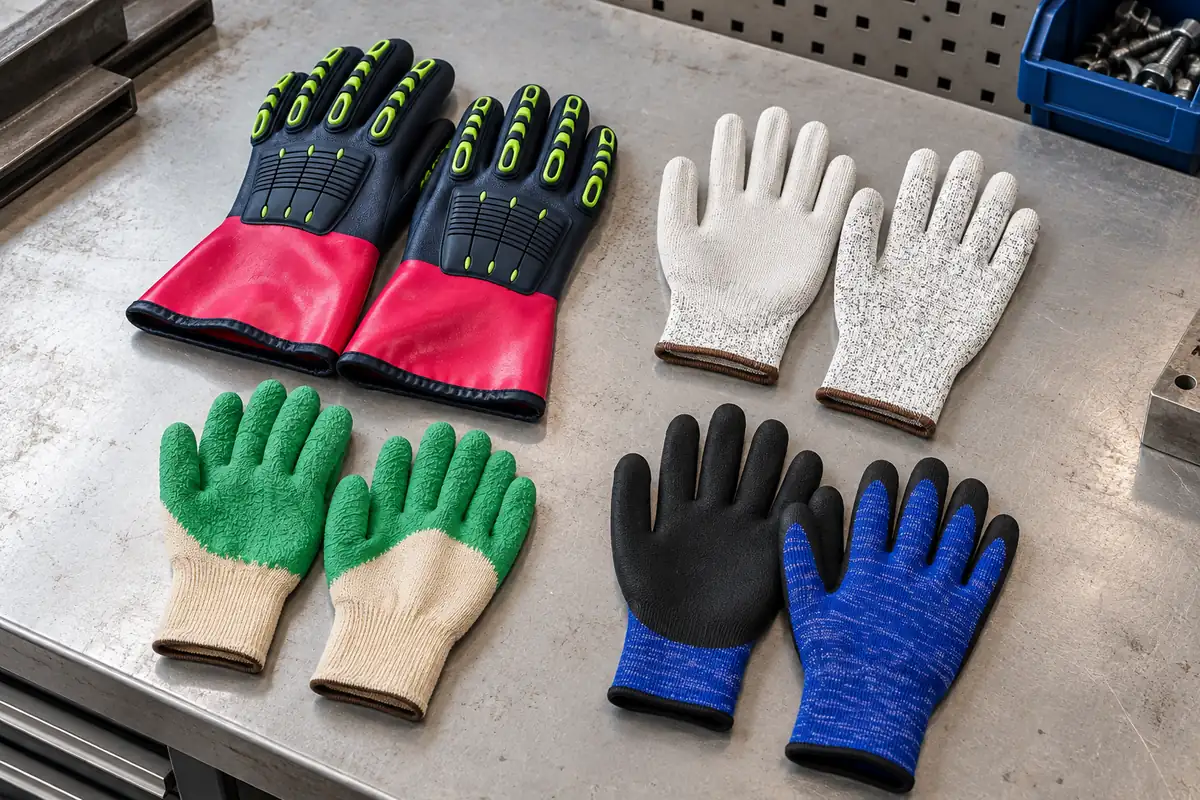
European glove standards at a glance
| Hazard or requirement | Main standard | What it evaluates |
|---|---|---|
| General requirements | EN ISO 21420:2020 | Design, sizing, innocuousness, marking and manufacturer information |
| Mechanical risks | EN 388:2016+A1:2018 | Abrasion, blade cut, tear, puncture, TDM cut and optional impact |
| Chemical risks | EN ISO 374-1:2016+A1:2018 | Permeation against identified test chemicals and glove classification |
| Microorganisms | EN ISO 374-5:2016 | Bacteria, fungi and, when additionally tested, viruses |
| Thermal risks | EN 407:2020 | Flame, contact, convective and radiant heat, plus molten metal |
| Cold | EN 511:2006 | Convective cold, contact cold, and optional water penetration |
| Welding | EN 12477:2001+A1:2005 | Mechanical and thermal requirements for Type A or Type B gloves |
| Electrostatic properties | EN 16350:2014 | Vertical resistance under specified conditions |
| Hand-arm vibration | EN ISO 10819:2013+A1:2019 | Vibration transmissibility in defined laboratory ranges |
Standards and their harmonised status can change. Confirm the exact edition on the EU Declaration of Conformity and consult the current EU harmonised standards publication before ordering.
1. Start with Regulation (EU) 2016/425
Regulation (EU) 2016/425 replaced Council Directive 89/686/EEC. It defines essential health and safety requirements and conformity assessment routes. A CE mark alone therefore does not select a suitable glove for you. Verify the intended use, PPE category, applicable standards, product identity, responsible economic operator and EU Declaration of Conformity.
- Category I: simple risks whose effects the user can recognise in time.
- Category II: risks outside Categories I and III; many general mechanical gloves fall here.
- Category III: risks that may cause death or irreversible damage to health. Some chemical, extreme heat, and extreme cold protection falls here.
Your supplier should explain the category and provide documentation for the exact model you will receive.
2. EN ISO 21420:2020: general glove requirements
EN ISO 21420 replaced EN 420. It addresses design, sizing, dexterity-related information, innocuousness, marking, and instructions. It works with a hazard-specific standard such as EN 388 or EN ISO 374.
Do not treat EN ISO 21420 as proof of cut, chemical, heat or cold protection. It supports a protection claim but does not replace the relevant hazard test.
3. EN 388 for mechanical risks
EN 388:2016+A1:2018 covers abrasion, blade cut, tearing, and puncture. Its marking can contain six positions: abrasion, coup-blade cut, tear, puncture, TDM cut, and optional impact protection. An “X” means a test was not performed, or the result is not applicable; it does not mean zero protection.
For sharp metal, glass, or blades, examine the TDM cut letter from A to F. A higher letter indicates a higher measured force in that test, but no glove is cut-proof. Dexterity, grip, coverage, and the actual edge still matter. Read our EN 388 marking guide. If you sell into North America, also review the ANSI/ISEA 105 cut-level guide; the two scales are not directly interchangeable.
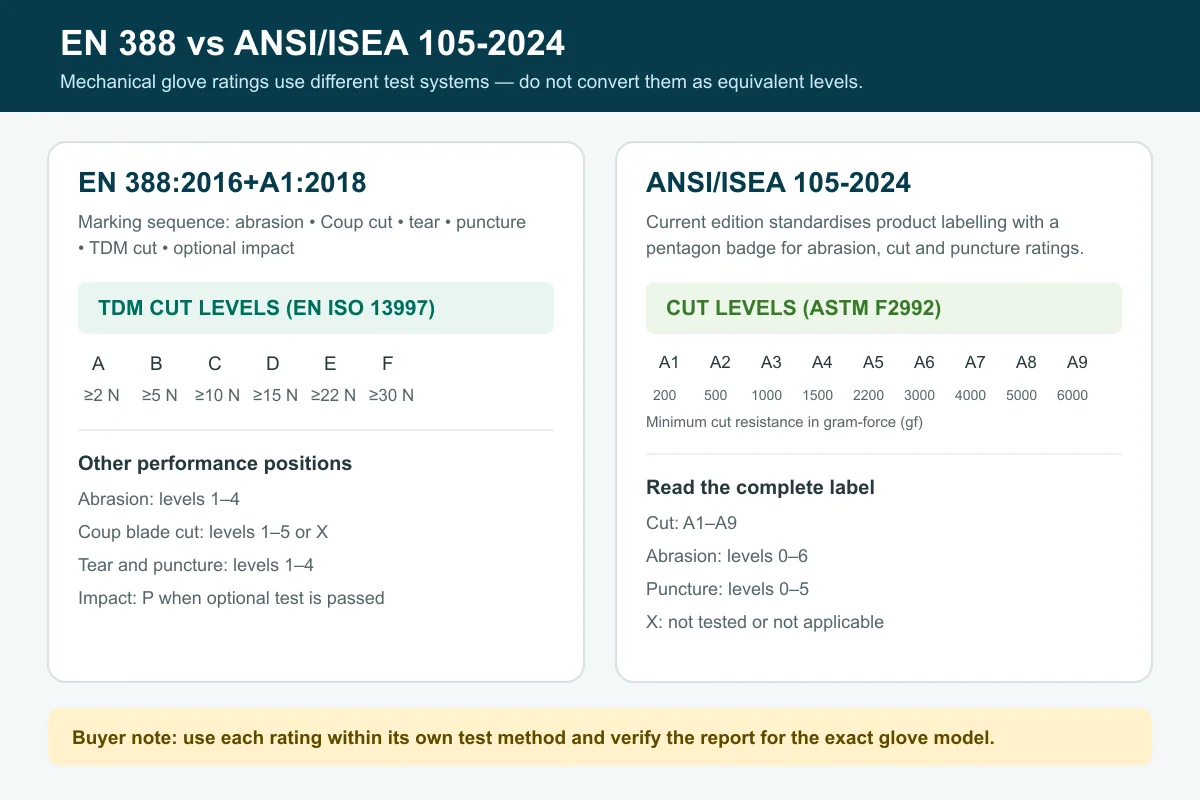
EN 388 and ANSI/ISEA 105 use different test and marking systems; their levels should not be treated as direct equivalents.
4. EN ISO 374 for chemicals and microorganisms
Begin with the chemical name, concentration, temperature, contact pattern, and expected exposure time. EN ISO 374-1 classifies chemical gloves using permeation results for specified chemicals. Laboratory breakthrough time applies to the tested material and conditions; it is not automatically a safe workplace wear time.
EN ISO 374-5 covers microorganisms. A virus claim requires the additional viral penetration test and corresponding marking. Request full test data and read the limitations in the user instructions. Our chemical-resistant glove range is a starting point; final selection must follow chemical-specific evidence.
5. EN 407 for heat and flame
EN 407:2020 evaluates several thermal hazards rather than giving one universal heat score. Depending on the claim, results can cover limited flame spread, contact heat, convective heat, radiant heat, small molten-metal splashes, and large quantities of molten metal.
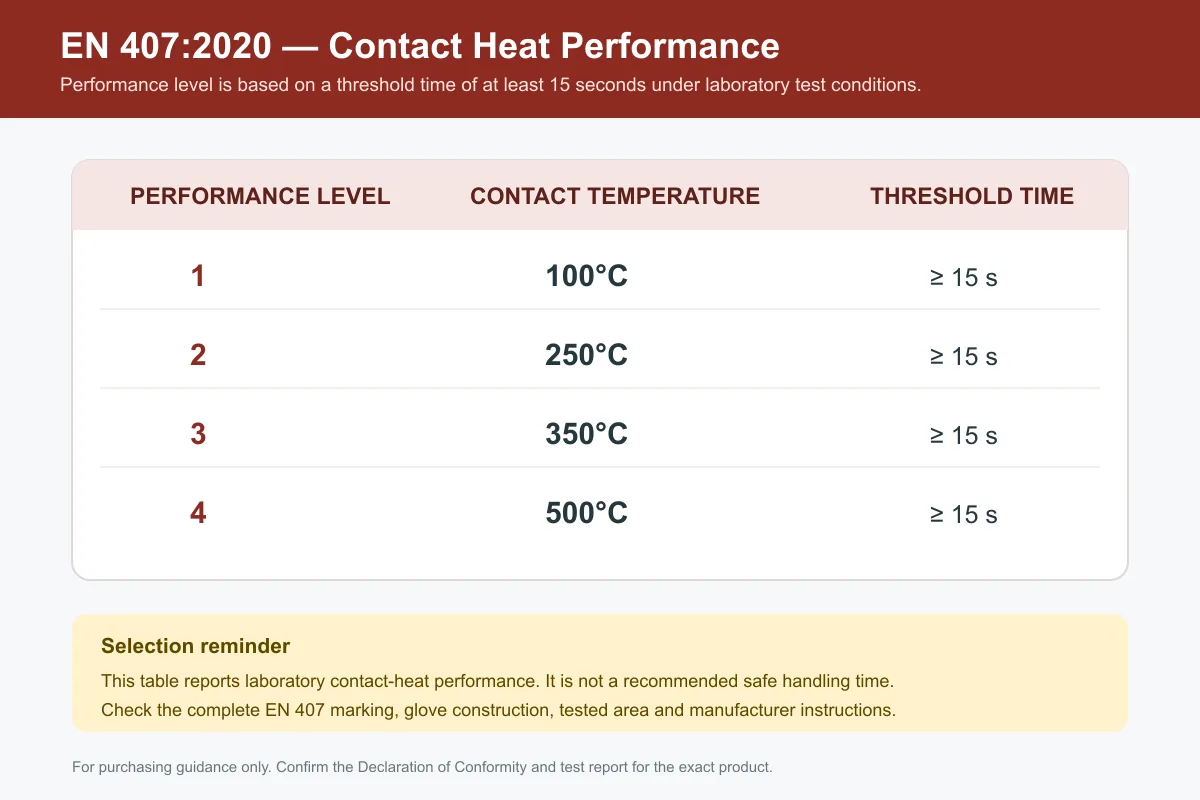
A glove chosen for brief contact with a hot component may be unsuitable near flame or molten metal. Confirm the tested area, cuff coverage, and dexterity you need before viewing heat-resistant glove options.
6. EN 511 for cold environments
EN 511 reports convective cold, contact cold, and water penetration. Also evaluate wind, moisture, exposure time, activity level, and temperature-zone transitions. A thick liner may improve insulation but reduce grip, while a wet glove can lose useful thermal performance.
For cold stores, logistics and winter construction, combine test results with a wearer trial. Our guide to choosing winter work gloves explains insulation, coating structure and moisture management.
7. Standards for specialised work
EN 12477 for welding gloves
EN 12477 combines mechanical and thermal requirements. Type A generally prioritises protection with lower dexterity; Type B generally prioritises dexterity for work such as TIG welding. Select based on the welding process and exposure.
EN 16350 for electrostatic properties
EN 16350 specifies performance under defined conditions. The glove is only one component of a grounded system that can include clothing, footwear, and flooring. Do not describe an EN 16350 glove as electrically insulating.
EN ISO 10819 for anti-vibration gloves
EN ISO 10819 measures vibration transmission under laboratory conditions. A passing result does not guarantee equal reduction for every tool, frequency, or grip force. Use engineering controls, tool maintenance, exposure management and training as well.
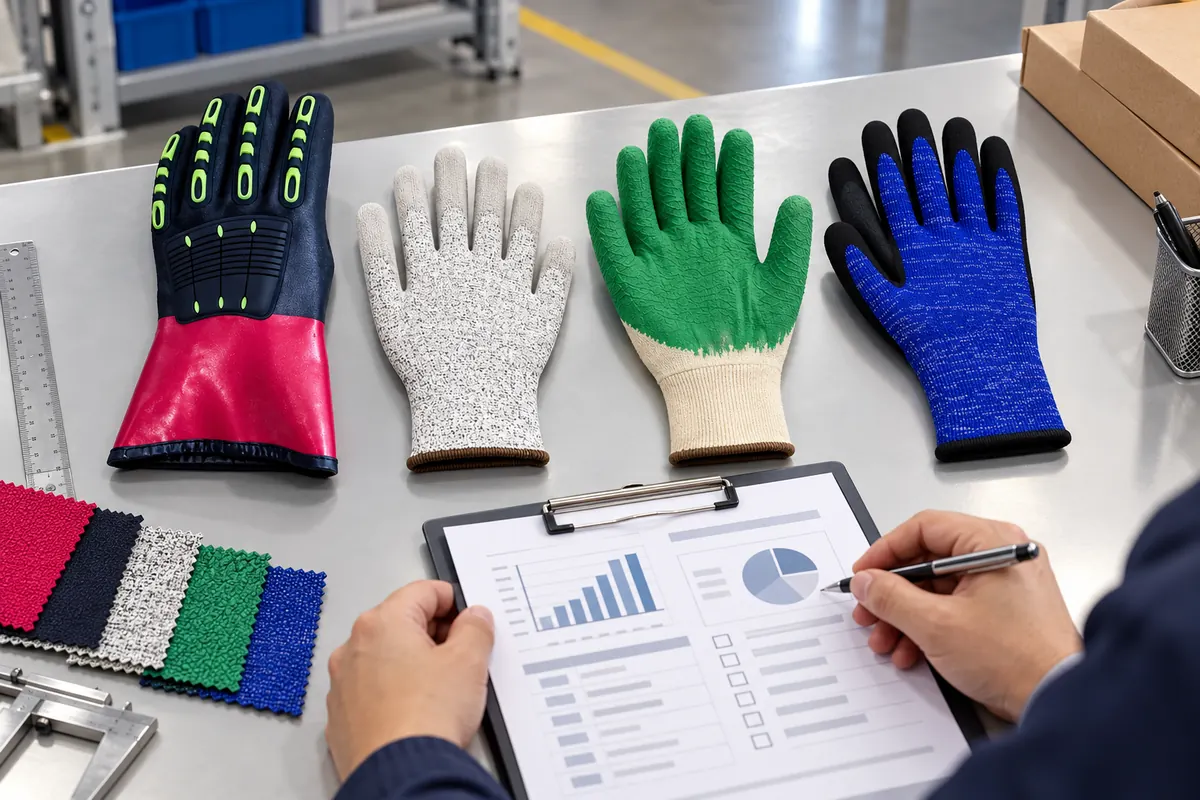
How to verify a glove before you buy
- Write the task and hazard profile. Record sharp edges, chemicals, temperature, duration, grip and dexterity needs.
- Match the product identity. The code on the glove, package, report and Declaration of Conformity should agree.
- Read the full marking. Record the edition and every position, including X and optional letters.
- Review the Declaration. Confirm the manufacturer, model, category, notified-body details where applicable and referenced legislation.
- Check test evidence. Confirm dates, materials, liner and coating. Do not apply one model’s report to another construction.
- Read the instructions. Check storage, cleaning, ageing, limitations and allergen information.
- Run a controlled trial. Confirm fit, grip, comfort and durability before a large order.
Common purchasing mistakes
- Choosing the highest score without identifying the hazard.
- Reading one pictogram digit while ignoring the others.
- Assuming CE marking makes one glove suitable for every task.
- Using old EN 420 or PPE Directive references without checking current documents.
- Comparing EN 388 and ANSI cut levels as if their scales were identical.
- Accepting a report that does not match the ordered material or model.
- Skipping a wearer trial when grip, comfort or cuff coverage affects the task.
Frequently asked questions
Does a CE mark prove that a glove is suitable for my job?
No. It indicates conformity for the declared intended use. Compare the declaration, standards, levels and limitations with your workplace risk assessment.
Is EN 420 still the current general glove standard?
EN ISO 21420:2020 replaced EN 420. If an older reference appears, ask the supplier to explain it and provide the applicable Declaration of Conformity.
What does X mean in an EN 388 marking?
It generally means that a test was not performed or is not applicable. It should not be read as performance level zero.
Can I compare an EN 388 cut letter directly with an ANSI cut level?
No. The methods and scales differ. Use each within its own test system and review the underlying result for a technical comparison.
How often should I recheck compliance documents?
Check before approving a new model or supplier and whenever the product, material, standard, legislation, or source changes. Periodic reviews help identify superseded or mismatched documents.
Build your specification from the hazard
A reliable specification connects the task, hazard, appropriate standard, and evidence for the exact product. Share your application, protection needs, sizes, coating preference, and quantity when you contact Everpro Gloves for a recommendation and documentation review.


