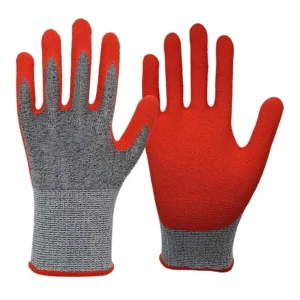
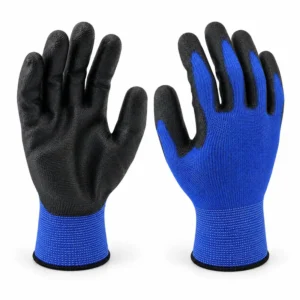
Quick answer: “Puncture-resistant” does not describe one universal hazard or test. If you handle nails, wire ends, burrs, or rough metal, look for a glove tested for the relevant industrial puncture method and confirm it in the product documentation. If your risk is a hypodermic needle, request needle-specific test data, such as ASTM F2878 results. A cut rating alone does not establish puncture or needlestick protection.
That distinction matters whether you are choosing gloves for a work crew or sourcing a product line. A glove may resist one type of point and perform differently against another. Start with the object, the force and direction of contact, and the consequence of a failure; then match the test report to that exposure.
Two different hazards: needle puncture and industrial puncture
Needle puncture
A hypodermic needle has a small, sharp tip that concentrates force over a tiny area. ASTM F2878 evaluates protective clothing materials against hypodermic needles under a defined laboratory method. It specifies common 21-, 25-, and 28-gauge needles and a controlled penetration setup; the method does not reproduce every real-world exposure or certify that a glove prevents every needlestick. A material-sample result alone does not establish protection across every part of a finished glove.
For healthcare, waste handling, laboratory work, or any task with a credible needle exposure, ask for needle-specific test data for the exact glove construction. Confirm which needle gauge and glove zones were tested and how the sample was prepared. Ordinary cut-resistant work gloves should not be represented as needlestick gloves without evidence for that hazard.
Industrial puncture
Industrial puncture and hypodermic-needle puncture are separate test categories. EN 388 reports mechanical puncture on a 1–4 scale, while ANSI/ISEA 105 has its own non-hypodermic puncture classification; ASTM F2878 evaluates material resistance to specified hypodermic needles. The tests use different probes, so a score in one category does not establish a score in the other. An industrial result can help you compare materials for selected mechanical point hazards, but it does not guarantee protection from every nail, splinter, metal burr, glass point, or sharp object at work. Tip shape, force, angle, backing, glove wear, and contact location all matter.
Check the test method and the protected area
Read the complete marking and technical file rather than relying on a generic “puncture-resistant” label. Check whether the result is for blunt industrial puncture or hypodermic needle puncture, which standard and scale were used, what material layers were tested, and which glove zones are covered. A palm result should not be assumed to apply to the back of the hand, fingertips, seams, or cuff. EN and ANSI levels are not interchangeable by number; compare the reported method and force data where available.
| Hazard you face | Evidence to request | What it does not prove |
|---|---|---|
| Nails, thicker wire, splinters, burrs | Non-hypodermic puncture result, test standard, probe and tested glove zone | Needlestick resistance or protection from every real object |
| Hypodermic needles | Needle-specific result such as ASTM F2878, tested gauge and material construction | Protection from every needle size, angle, force, or uncovered area |
| Blade edges or sheet material | Cut-resistance test and a separate puncture result if point hazards are present | That a cut score automatically provides puncture protection |
Cut resistance is not puncture resistance
Cut tests measure resistance to a blade moving across material. Puncture tests measure resistance to a point pushing through it. A high cut level can be useful when you handle sheet metal, glass edges, or sharp stock, but it does not automatically mean the glove will stop a nail or needle. Treat cut, puncture, abrasion, tear, impact, and chemical performance as separate properties unless the test documentation explicitly covers them.
How to choose puncture-resistant work gloves for the task
- Describe the point hazard. Record whether it is a needle, nail, wire end, thorn, splinter, burr, or another point, plus its likely sharpness and direction of contact.
- Estimate contact conditions. Consider hand force, pushing or pulling, repetitive handling, likely impact, and whether the point can be pressed against a hard backing.
- Choose the matching test evidence. Ask for the test standard and complete report, not only “puncture-proof” wording or a cut score. Confirm the result applies to the exact glove model and relevant area.
- Check the rest of the task. Compare grip, dexterity, abrasion, cut protection, impact protection, fit, cuff coverage, moisture and chemical exposure. If you handle oily steel, for example, secure grip and oil compatibility may be as important as mechanical resistance.
- Trial gloves safely. Evaluate fit and task control using the employer’s hazard assessment. Never test a glove by pushing a real needle or nail into it by hand.
- Inspect and replace. Punctures, cuts, worn coatings, separated seams, or embedded fragments can reduce protection. Follow the supplier’s care and replacement guidance.
What B2B buyers should request before ordering
If you are an importer, distributor, brand, or safety procurement team, build the hazard and evidence requirements into the product brief before requesting samples. Ask the manufacturer for:
- Exact model, size range, materials, coating coverage, and areas claimed to be protected.
- Test standard and report details for each claimed hazard, including the date, probe or needle, specimen layers, and tested area. Confirm the report represents the glove construction being quoted.
- Clarification on whether “puncture” means an industrial probe method or hypodermic-needle resistance.
- The relationship between test specimens and the finished glove: tested layers, leather or coating, thickness, construction, and coverage. Ask what the report does and does not represent.
- Sample traceability, production tolerances, change-control process, and confirmation that bulk production matches the approved sample.
- Packaging, labeling, private-label options, minimum order quantity, lead time, and any market-specific compliance documents you need.
Do not compare two suppliers’ puncture claims until you know the method and test setup are comparable. For private-label programs, keep the approved report, sample, technical data sheet, and artwork revision linked to the same model code.
Common selection mistakes
- Assuming a high ANSI/EN cut level also means needle protection.
- Treating “puncture-resistant” and “needlestick-resistant” as interchangeable marketing terms.
- Choosing by a rating number without checking the test method, probe, tested glove area, and report.
- Assuming a glove tested on a flat material sample performs identically after wear, flexing, moisture, or damage.
- Expecting one glove to address puncture, cut, impact, chemicals, and heat without checking each hazard separately.
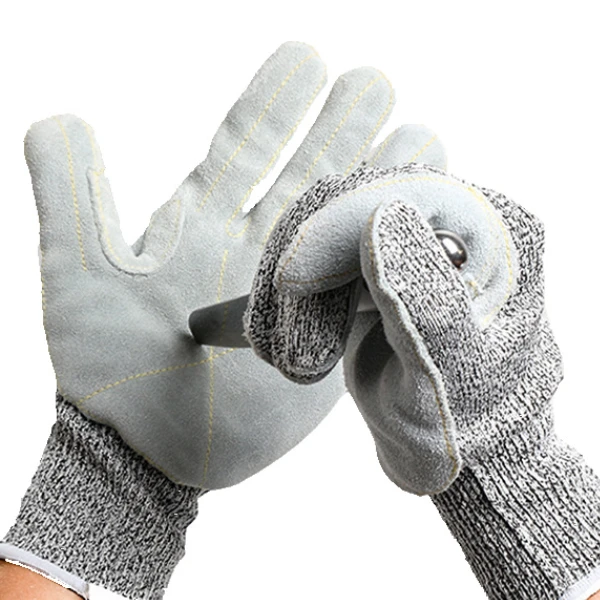
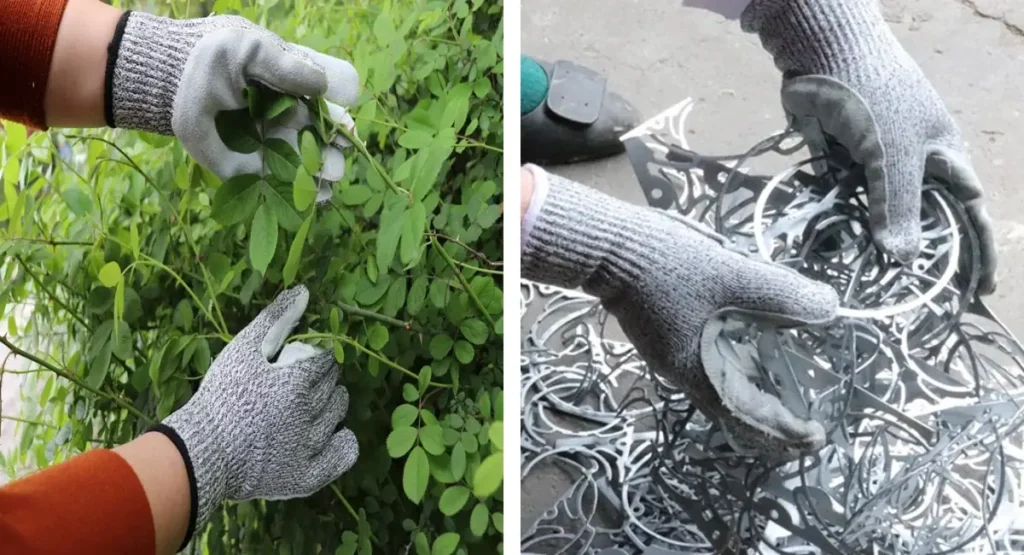
Everpro’s CUT-1401 HPPE and leather cut-resistant glove is relevant to sharp-edge and rough-material handling. Its product page lists an HPPE liner, leather palm, ANSI cut level 6, and applications including construction, glass, metal, automotive, and logistics. The page also places it in Everpro’s puncture-resistant glove category, but does not show a puncture-specific standard or rating. Ask Everpro for matching test documentation before selecting it for a puncture hazard; do not infer puncture protection from the cut rating, materials, or category label.
For related selection guidance, see Everpro’s guide to protective-glove standards and the cut-resistant glove range.
Frequently asked questions
Do puncture-resistant gloves protect against needles?
Not necessarily. Many industrial puncture tests use a different probe from the hypodermic needle method. For needle exposure, ask for test data from a needle-specific method such as ASTM F2878 and assess the limitations for your task.
Can cut-resistant gloves stop nails?
A cut rating alone cannot answer that. Blade-cut and puncture tests measure different performance. Request a puncture result for the exact glove and compare its method with the point hazard at your site.
What is the difference between industrial puncture and needlestick resistance?
Industrial puncture tests generally use a standardized probe intended to compare resistance to mechanical puncture. ASTM F2878 uses specified hypodermic needles. Results from one method should not be treated as equivalent to the other.
What should I ask a glove supplier before buying?
Ask which test method was used, request the full report for the exact glove model, clarify whether it covers needle or industrial puncture, and confirm that the tested construction matches the sample and production specification.
Are “puncture-proof” gloves completely puncture-proof?
No glove should be assumed to block every point under every force and condition. Treat “puncture-resistant” as performance against a defined test, then assess the work task, glove condition, and residual risk.
Sources
- ISEA standards listing: ANSI/ISEA 105-2024.
- ISEA Key to Hand Classifications poster for ANSI/ISEA 105-2024.
- ASTM F2878-19(2024), Standard Test Method for Protective Clothing Material Resistance to Hypodermic Needle Puncture.
- ASTM F1342/F1342M-05(2022), Standard Test Method for Protective Clothing Material Resistance to Puncture.
- OSHA 29 CFR 1910.138, Hand Protection.
- OSHA Appendix B to Subpart I, PPE hazard assessment and selection guidance.
Use this guide as a selection aid, not as a certification or guarantee. Employers should assess workplace hazards and verify glove suitability with the manufacturer and applicable local requirements.