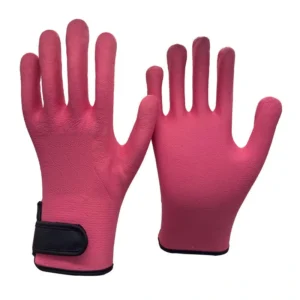
Quick answer: Choose glass-handling gloves by assessing the glass edges, handling method, grip conditions, forearm exposure, and task duration. For sharp sheet edges, start with a task-appropriate cut-resistant glove and verify its rating, fit, and grip in a controlled workplace trial. A cut rating does not make a glove cut-proof, puncture-proof, or suitable for every glass task. If you buy for a team, compare the complete glove specification and sample performance—not just the headline cut level.
Start with the glass task, not a single cut level
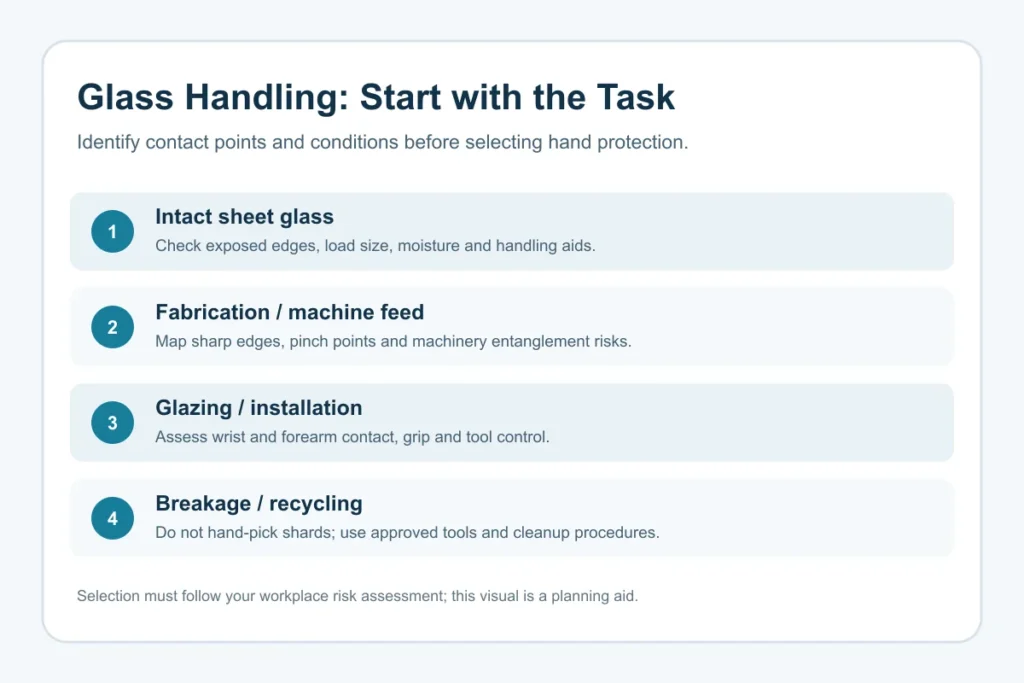
“Glass handling” can mean moving intact panes, feeding glass into a machine, installing windows, sorting broken material, or clearing a breakage. Each task exposes your hands differently. Before you choose gloves, identify the sharp edge locations, load weight and size, whether the surface is wet or dusty, how much fingertip control you need, and whether your forearms can contact an edge.
For employers in the United States, OSHA requires hand protection to be selected from an evaluation of the task, conditions, duration, and identified hazards. Use your site risk assessment and applicable local rules as the starting point.
| Task | Selection questions | What to verify in a trial |
|---|---|---|
| Moving intact sheet glass | Are edges exposed? Is the pane large, heavy, wet, or smooth? | Secure grip, controlled lift, fit and cuff coverage; use team or mechanical handling where required. |
| Glass fabrication or machine feeding | Where are sharp edges and pinch points? Is the glove used near moving equipment? | Dexterity and task compatibility. Follow machine-guarding procedures; gloves can create entanglement hazards near rotating parts. |
| Glazing and window installation | Can edges contact the wrist or forearm? Do you need to handle fasteners or tools? | Hand and forearm coverage, grip while positioning, and secure fit without excess bulk. |
| Breakage cleanup or recycling | Are shards loose, hidden, or contaminated? Are puncture hazards present? | Do not hand-pick shards. Use tools and approved cleanup procedures; select protection for both cut and puncture risks. |
What to look for in glass handling gloves
1. A documented cut-resistance rating
Compare gloves tested to the standard required in your market, such as ANSI/ISEA 105 in the United States or EN 388 in Europe. Do not compare level labels across systems as if they were identical. Ask for the test standard, report, or technical data sheet for the exact model and construction. A rating describes performance in a specific test; it does not guarantee protection from every edge, force, motion, or broken shard.
Use your hazard assessment to set the minimum performance requirement. Higher is not automatically better if extra thickness, stiffness, or reduced dexterity makes the task harder to control. Reassess the selected glove with workers and supervisors.
You may see general guides assign a fixed ANSI range to “glass handling.” Use such ranges only as an initial screening prompt, not a universal prescription. Moving intact architectural panes, feeding glass into a line, and clearing broken shards present different edge, puncture, grip, and coverage risks. Set your requirements based on the actual job and verify the exact glove model’s test data.
2. Grip matched to the surface
Glass can be smooth, dusty, damp, or coated with process residue. A glove that grips well on a dry sample may behave differently on wet glass. Check the palm coating, texture, and grip in the conditions you actually encounter. Where the glass surface must remain clean, test whether the glove leaves marks, lint, or residue before adopting it for finished products.
3. Coverage matched to edge contact
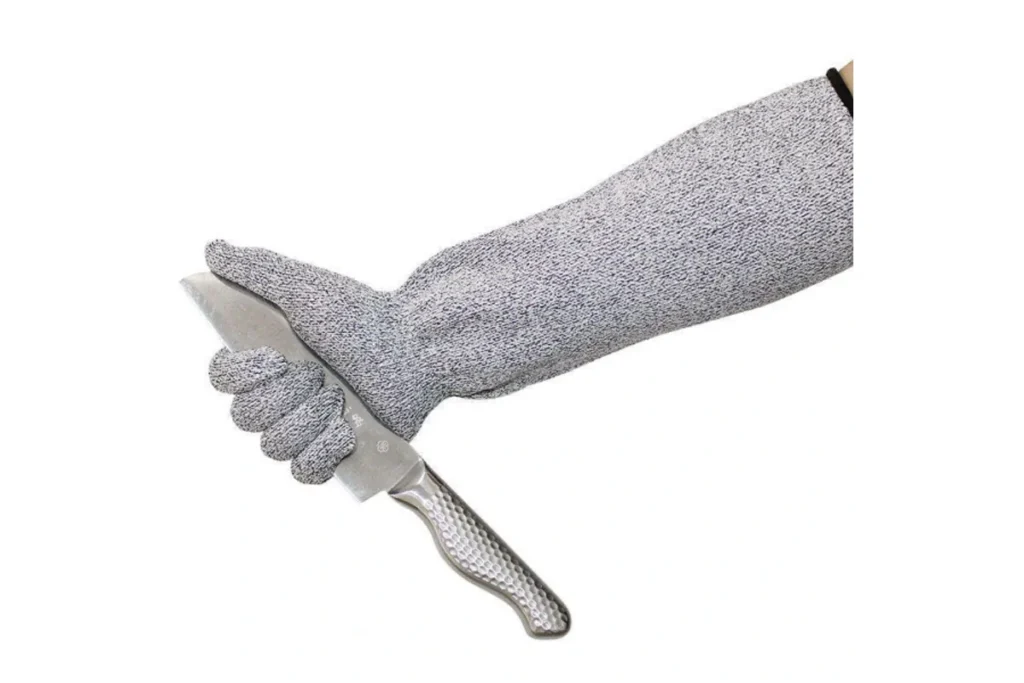
A palm-coated glove can offer palm grip while leaving much of the back of the hand uncoated. A long-cuff gauntlet extends coverage over the wrist and forearm, which may matter when those areas can contact sheet edges. More coverage can also add heat and restrict movement, so confirm it does not interfere with safe handling.
4. Fit and dexterity
Your glove should stay in place while you grasp, guide, and release the load. Excess material at the fingertips can reduce control; a tight glove can fatigue your hands. Trial all required sizes and include representative workers, tasks and shifts. If you need to use suction lifters, clamps or other handling equipment, test the glove with that equipment.
5. Separate risks that cut resistance does not cover
Cut resistance is not the same as puncture, impact, chemical, heat or electrical protection. Glass splinters can puncture; laminated or chemically treated glass may introduce other hazards. Select each required protection feature from the risk assessment and the manufacturer’s verified data. Never rely on a glove alone where engineering controls or mechanical handling are needed.
How buyers can compare samples before a bulk order
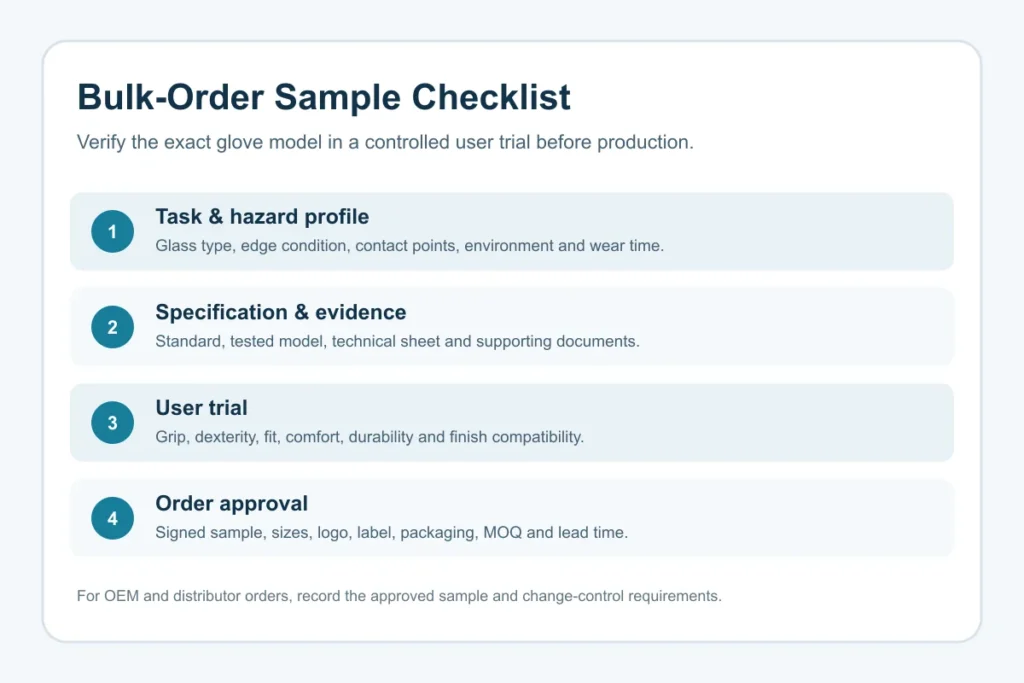
- Write a task profile: glass type, edge condition, handling method, contact points, environment, and wear time.
- Set required standards and performance levels, and request the exact model’s technical sheet and test documentation.
- Shortlist glove construction: liner, coating or grip finish, cuff length, size range, and any reinforcement.
- Run a controlled sample trial with trained users. Record grip, dexterity, fit, comfort, durability, and any effect on glass finish.
- Check care instructions, inspection criteria, replacement triggers, and how performance may change after cleaning.
- Before bulk production, approve a signed sample and confirm color, size mix, labeling, packaging, logo, carton quantity, MOQ, and lead time.
For an OEM or distributor order, keep the approved specification and sample reference with the purchase order. Ask the supplier to identify any material, construction, or test-level change before shipment.
Example: an extended-cuff option for glass and sharp-edge work
Everpro’s CUT-2001 Long HPPE A5 Cut-Resistant Gauntlets are listed with an ANSI A5 cut level, HPPE construction, silicone reinforcement at the thumb web, and a 45 cm integrated gauntlet. The page lists glass handling among its applications. That makes it a candidate to evaluate when forearm coverage is part of your task profile. Confirm fit, grip, product documentation, and suitability for your exact process before ordering.
Explore the broader glass handling gloves range or cut-resistant glove selection. For a rating overview, read how to choose cut-resistant gloves. You can also contact Everpro with your application, target standard, sizes, quantity, and customization requirements.
Workplace use, inspection and replacement
Train workers to check gloves before use for cuts, holes, pulled yarn, coating damage, contamination, poor fit, or loss of grip. Remove damaged gloves from service. Follow the manufacturer’s cleaning and care instructions; do not assume washing leaves protective performance unchanged unless the product data supports it. Review incidents and near misses, then revisit the glove choice when the glass, process, tooling or work method changes.
Use suitable glass racks, edge guards, suction equipment, team lifts and controlled routes where the risk assessment calls for them. Keep hands away from pinch points and never use gloves as a substitute for safe equipment or procedure.
Frequently asked questions
What gloves should you use for handling glass?
Use gloves selected for the glass edges, handling method, grip conditions and forearm exposure, with a verified cut-resistance rating appropriate to your assessed risk. Confirm the choice in a workplace trial.
Are cut-resistant gloves cut-proof?
No. Cut-resistant ratings indicate performance in a defined test. Sharp edges, force, motion, wear and fit can change the risk, and the glove may still be cut or damaged.
Do you need A5 gloves for glass handling?
Not for every glass task. Set the required performance through a task-specific hazard assessment and applicable standards. Then check dexterity, grip, and coverage with users.
Should you wear gloves to pick up broken glass?
Do not pick up shards by hand. Follow your breakage-cleanup procedure and use tools and protection selected for cut, puncture, and contamination hazards.
Are long-cuff glass handling gloves always safer?
No single cuff style fits every job. Extended cuffs can add forearm coverage where edges may contact the arm, but they can add bulk or heat. Test coverage and safe movement in the actual task.
What should you request from a glove supplier?
Request the exact model specification, applicable test documentation, sizes, materials, cuff and coating details, care instructions, sample, packaging, MOQ, lead time, and change-control process.