
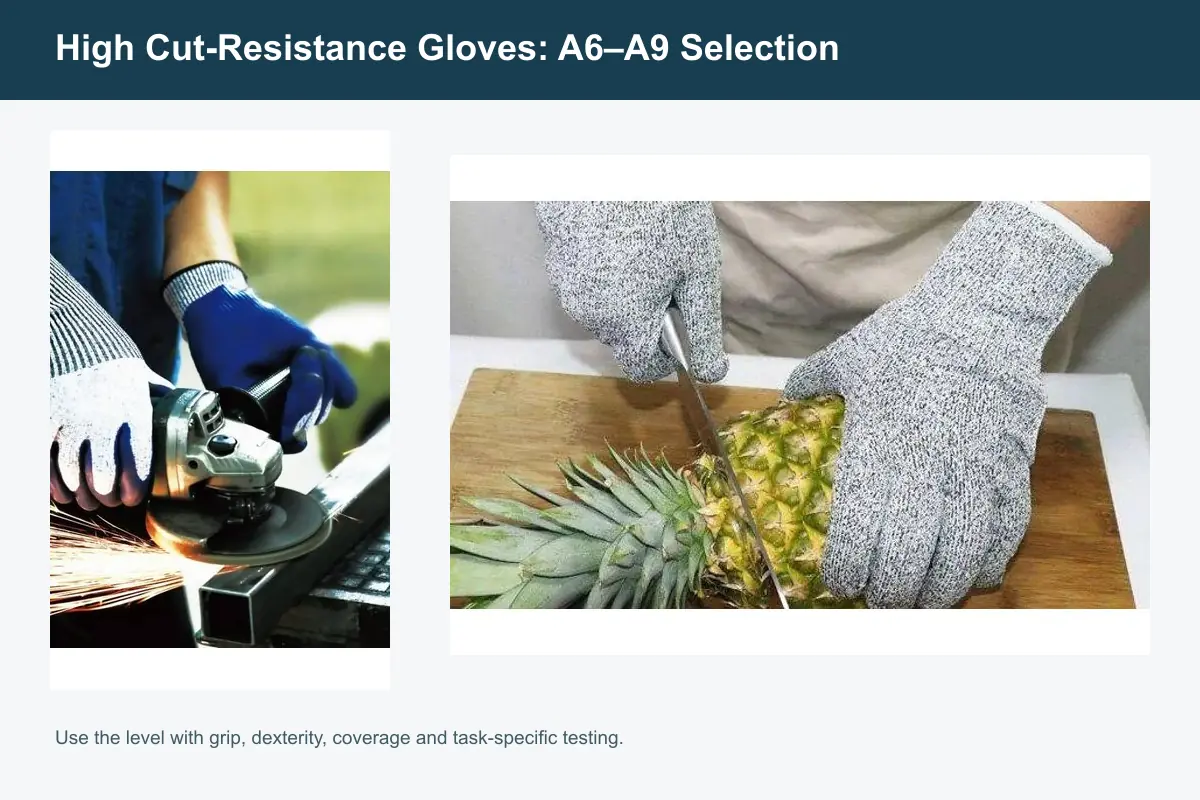
High cut-resistant gloves rated ANSI A6–A9 are intended for demanding sharp-edge hazards, but a higher number is not automatically the safest purchasing decision. You still need enough grip, dexterity, coverage, and durability for the task, and you must control the hazard with guarding, tools, and procedures before relying on gloves.
This guide helps you decide when A6–A9 may be appropriate and how to compare complete glove constructions without treating any product as cut-proof.
What A6–A9 mean
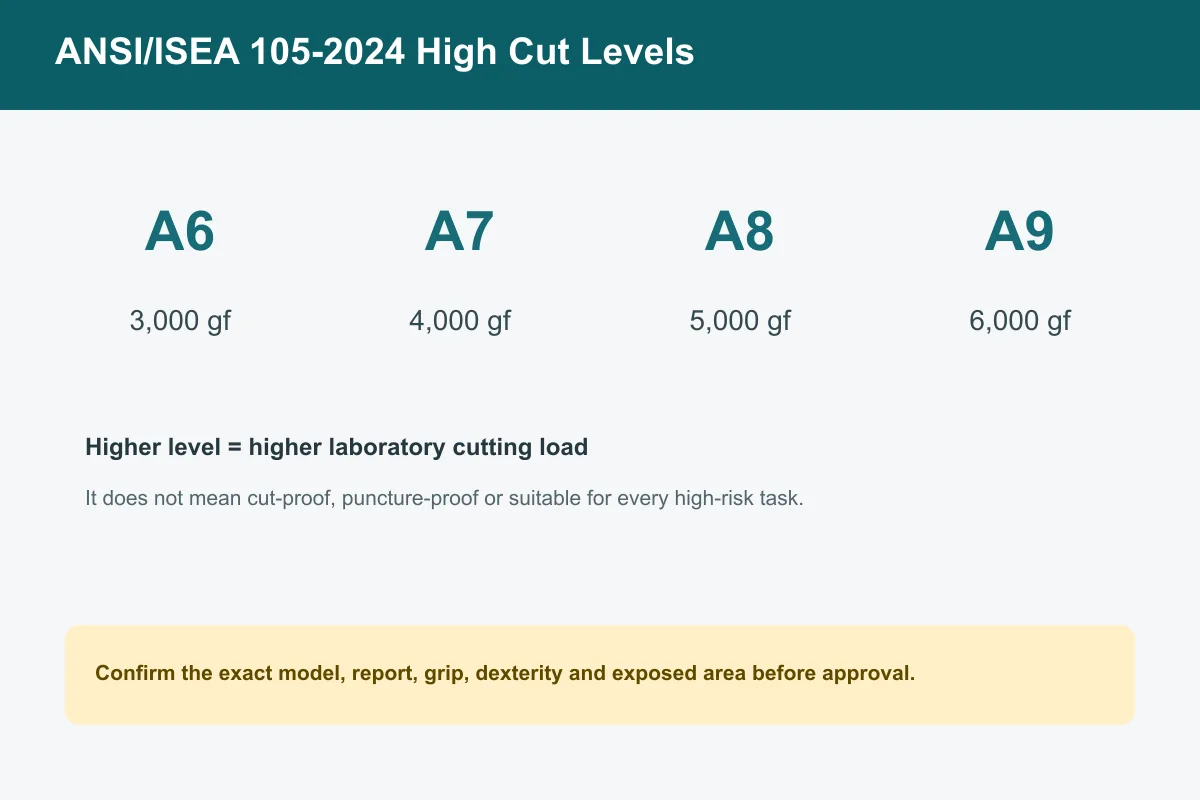
| ANSI/ISEA 105-2024 level | Minimum cutting load | Selection context |
|---|---|---|
| A6 | 3,000 gf | High cut hazards such as demanding metal fabrication or recycling tasks |
| A7 | 4,000 gf | High exposure involving sharper edges or greater handling force |
| A8 | 5,000 gf | Very high cut exposure confirmed by task assessment |
| A9 | 6,000 gf | Highest classification in the ANSI scale for extreme cut hazards |
ANSI/ISEA 105-2024 uses ASTM F2992-23 cut testing. The result describes laboratory resistance to a blade travelling through the material. It does not predict every workplace cut and does not make the glove safe for direct blade contact.
When a high cut level may be appropriate
Sharp metal stamping and fabrication
Freshly stamped edges, burrs, and heavy sheet can combine sharpness with substantial handling force. Assess part weight, edge orientation, repetitive abrasion, and oily contamination.
Glass manufacturing and handling
Large panes, unfinished edges and broken glass can justify higher protection. Also evaluate grip, puncture, forearm coverage and procedures for damaged material.
Metal and waste recycling
Unpredictable hidden edges create variable exposure. A higher level may be considered alongside puncture resistance, impact protection, visibility, and strict inspection intervals.
Blade change and maintenance
Apply lockout, guarded handling tools and blade carriers first. A6–A9 gloves may address residual exposure, but gloves should never replace isolation and safe handling procedures.
Heavy cable, wire and slitter operations
Wire ends, steel strapping and slitter blades can produce severe lacerations. Map the contact point and determine whether the hand, wrist or forearm needs coverage.
Why you should not automatically select A9
Higher performance can involve denser yarns, reinforcement, or added thickness. If the result is too stiff, workers may lose tactile control, apply excessive grip force, or remove the glove. Modern engineered yarns can reduce this trade-off, but only a wearer trial can show whether the glove works with your tools and parts.
Select the lowest level that your documented risk assessment and testing show is adequate, then confirm the glove remains usable throughout the shift.
Compare the complete glove construction
Liner and reinforcement
HPPE, aramid, steel, glass fibre and composite yarns can reach high levels with different weight, flexibility and comfort. Confirm that the test report matches the supplied yarn and knitting construction.
Palm coating and grip
PU may support dry precision work, while foam or sandy nitrile can be considered for oily handling. Crinkle latex may provide strong grip in some construction or glass tasks. Test the real surface and contamination conditions.
Abrasion and puncture
Cut level does not replace abrasion or puncture ratings. Repeated rubbing can damage protective fibres, while wire and fragments may create puncture hazards requiring separate testing.
Coverage
Inspect fingertips, finger sides, thumb crotch, wrist and forearm. A high-rated palm material does not protect an uncovered area. Add cut-resistant sleeves when the task exposes the arm.
Fit and dexterity
Approve every size used by the workforce. Check tool control, fasteners, machine interfaces, hand fatigue and whether the protective material stays aligned during a full grip.
A6–A9 compared with EN 388
ANSI A6–A9 and EN 388 ISO 13997 levels are not direct equivalents. ANSI reports A1–A9 in grams-force, while EN 388 reports TDM cut levels A–F in newtons together with other mechanical results. Use the applicable standard and test report for the destination market.
Review our ANSI/ISEA 105-2024 guide, EN 388 guide, and A1–A9 level-selection guide for the wider classification context.
High cut glove field-trial checklist
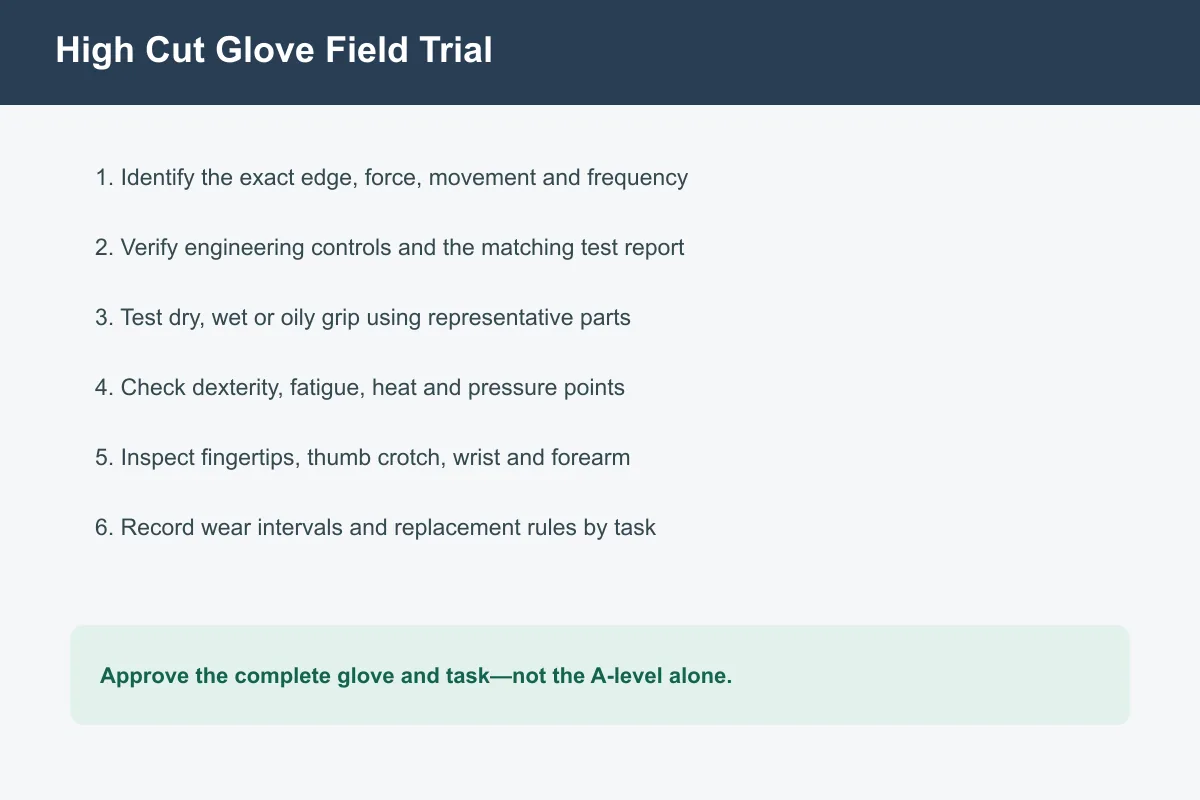
OSHA 29 CFR 1910.138 requires employers to select hand protection according to the task, conditions, duration of use and identified hazards. Use the following checklist to document that selection.
- Identify the exact edge, force, direction, and frequency.
- Confirm engineering controls and safe handling procedures are in place.
- Verify the glove model and ANSI/ISEA 105-2024 report.
- Test grip with representative dry, wet, or oily parts.
- Check dexterity, fatigue, heat, and pressure points over a normal work period.
- Inspect high-wear areas after defined cycles.
- Record replacement rules and worker feedback by task and size.
Supplier documents to request
- Test report identifying the exact model, liner, and coating.
- Cut, abrasion and puncture classifications.
- Product marking and destination-market documentation.
- Size specification and construction tolerance.
- Yarn, coating and supplier-change controls.
- Production samples and agreed quality inspection criteria.
Frequently asked questions
Are A9 gloves cut-proof?
No. A9 is the highest ANSI cut classification, but blade sharpness, force, movement, wear and exposed areas still affect injury risk.
Is A6 enough for sheet metal?
It may be suitable for some high-risk sheet-metal tasks, but edge condition, weight, force, frequency and secondary hazards determine the required construction.
Do higher levels always mean thicker gloves?
No. Engineered yarns can deliver higher performance in finer constructions, although each glove must be evaluated for comfort and durability.
Does A9 protect against needles?
Do not assume so. Needlestick and industrial puncture hazards require separate testing and selection.
Should you use the same glove for every department?
Usually not. Different tasks can require different grip, dexterity, coverage, and secondary protection even when their cut ratings are similar.


