
You cannot choose chemical-resistant gloves safely from the material name alone. “Nitrile,” “PVC” or “neoprene” describes a polymer family, but protection changes with the exact formulation, thickness, chemical, concentration, temperature, and contact time. Start with the safety data sheet (SDS), then verify the glove manufacturer’s chemical-resistance data for the exact product.
This guide gives purchasing teams and safety managers a practical method for comparing chemical-resistant work gloves without treating any material as universally protective.
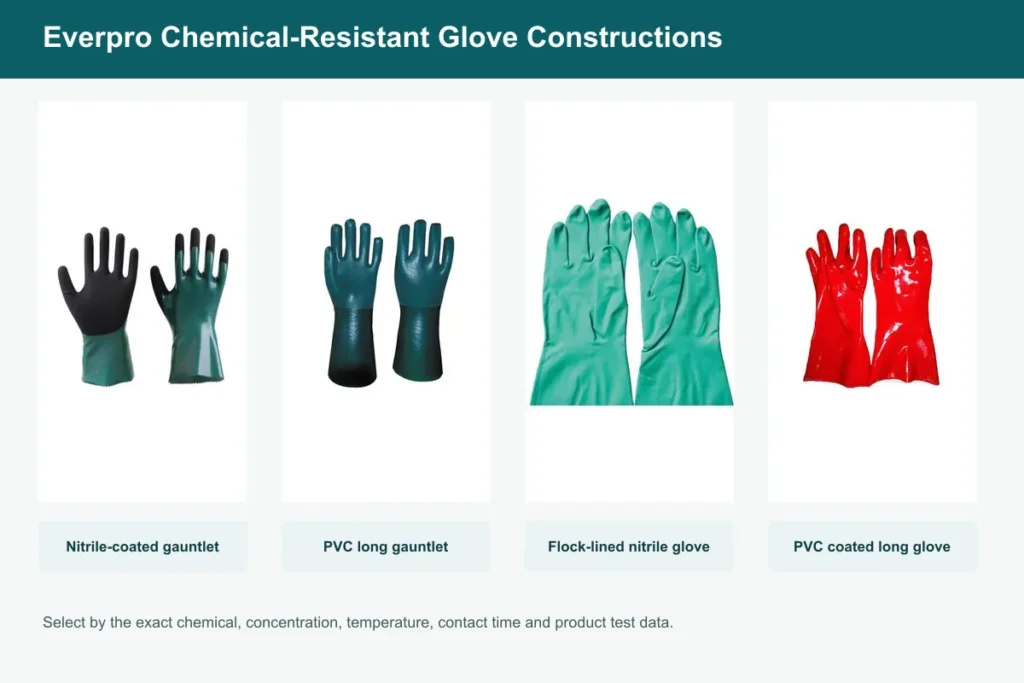
What chemical-resistant gloves must control?
OSHA requires employers to select hand protection by evaluating its performance against the task, conditions, duration, and identified hazards. For chemical work, you should consider three different failure mechanisms:
- Permeation: molecules move through the glove material at a level that may be invisible.
- Penetration: liquid passes through pinholes, seams, closures or other physical openings.
- Degradation: the material swells, softens, cracks, shrinks, becomes sticky or otherwise loses useful properties.
A glove can look intact while a chemical permeates through it. Visual inspection is necessary, but it cannot replace chemical-specific test data.
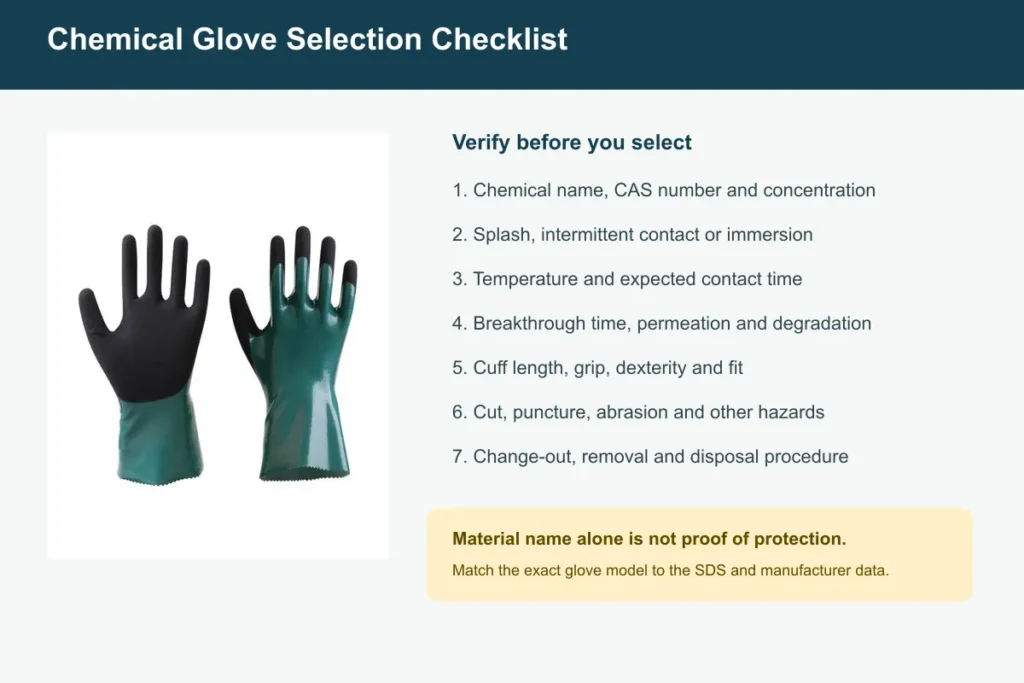
Seven steps for selecting chemical-resistant gloves
1. Identify every chemical and mixture
Record the product name, chemical ingredients, CAS numbers and concentration. Review the current SDS, especially the hazard, handling and personal protection sections. If you are handling a mixture, do not assume that data for each ingredient predicts the mixture’s behaviour. Solvents can carry other ingredients through a glove, and mixture breakthrough may be faster than expected.
2. Define the contact pattern
Distinguish brief splash, repeated splash, intermittent handling and continuous immersion. Also record whether the worker’s hand or forearm may enter a tank, whether liquid can run into the cuff, and whether contaminated objects will be gripped repeatedly.
3. Record temperature and exposure time
Higher temperatures often increase permeation. Hand warmth, flexing, and pressure at grip points can also reduce real-world protection compared with a flat laboratory sample. Use the reported breakthrough time as test information, not as an automatic safe-wear time.
4. Check chemical-specific compatibility data
Use the manufacturer’s chart or test report for the exact glove model, thickness, and chemical concentration. Look for breakthrough time, permeation rate, and degradation result. Do not transfer a result from one brand, formulation or thickness to another product.
5. Add the physical hazards
Chemical work may also involve cut edges, puncture, abrasion, heat, cold, or impact. A thin unsupported glove may offer chemical compatibility but fail quickly during metal handling. A supported PVC gauntlet can improve durability and coverage but reduce dexterity. Specify each required property separately.
6. Choose coverage, grip and fit
Select cuff length from the likely splash direction and immersion depth. Check whether the cuff can trap liquid, whether the palm texture works in wet or oily conditions, and whether the size allows safe tool control. A glove that workers remove because it is hot, loose, or stiff provides little practical protection.
7. Set a change-out and disposal plan
Define when gloves are replaced, whether reuse is permitted and how contaminated gloves are removed. Base the plan on test data, exposure conditions, and workplace evaluation. Replace gloves immediately after suspected breakthrough, visible degradation, puncture, internal contamination, or loss of integrity.
How common glove materials differ
| Material | Useful screening characteristics | Important limitations |
|---|---|---|
| Nitrile | Often considered for oils, fuels, greases, and some chemicals; good abrasion and puncture performance in many industrial constructions | Performance varies widely; many ketones and other solvents can permeate or degrade particular nitrile formulations |
| Neoprene | Often evaluated for acids, caustics, alcohols and some oils or solvents | Not universal; verify the exact chemical, concentration and formulation |
| PVC | Commonly used for many acids, bases, salts, water-based chemicals and some oils; supported gauntlets offer coverage and durability | Can perform poorly with certain ketones, aromatic solvents and other chemicals; plasticiser loss and cold stiffness may matter |
| Natural rubber/latex | Flexible and often considered for water-based acids and alkalis | Usually unsuitable for many oils and hydrocarbon solvents; latex proteins may cause allergy |
| Butyl rubber | Often evaluated for ketones, esters and some gases | Can have limited resistance to many hydrocarbons and may reduce dexterity |
| PVA | Can resist some aromatic and chlorinated solvents | Water sensitive; unsuitable where water or high humidity can affect the barrier |
| Barrier laminate | Broad chemical screening range in some constructions | Fit, grip, durability and dexterity may require an outer glove or task-specific system |
This table narrows your search; it does not approve a glove. Confirm compatibility with the exact manufacturer data.
Understanding breakthrough time
Breakthrough time is measured under defined laboratory conditions. It is the period before a specified permeation rate is detected through the test material. It does not mean that the chemical suddenly becomes visible or that the glove is safe for that entire period in every workplace.
Actual protection can be shortened by higher temperature, thinner material at flex points, abrasion, previous use, contamination inside the glove, mixtures, and manufacturing variation. OSHA’s technical guidance specifically warns that workplace breakthrough can be earlier than a published laboratory value.
EN ISO 374 markings for chemical gloves
For products placed on the European market, EN ISO 374-1 addresses terminology and performance requirements for chemical risks, while EN ISO 374-5 covers microorganisms. Chemical gloves may be classified as Type A, B or C according to permeation performance against specified test chemicals.
- Type A: at least performance level 2 against at least six listed test chemicals.
- Type B: at least performance level 2 against at least three listed test chemicals.
- Type C: at least performance level 1 against at least one listed test chemical.
The letters under a pictogram identify tested chemicals, not universal chemical resistance. Check the Declaration of Conformity, full test results, and limitations for the exact glove.
Supported versus unsupported chemical gloves
Unsupported gloves are made primarily from the barrier polymer. They can provide good liquid coverage and are available in different thicknesses and cuff lengths. Supported gloves apply a polymer coating over a textile liner. The liner can improve comfort and mechanical strength, but the complete construction, coating continuity, and cuff design determine where it is suitable.
A palm-coated work glove is not automatically a chemical-protective glove. If the coating does not fully cover the hand, liquid can reach the liner and skin. Use partial coatings for grip or mechanical work only when the exposure assessment permits them.
Inspection, use and removal
- Inspect the glove before each use for cuts, pinholes, swelling, hardening, stickiness, colour change and damaged cuffs.
- Confirm that the inside is dry and uncontaminated.
- Keep cuffs positioned to prevent liquid from entering, considering whether arms are raised or lowered during the task.
- Do not touch phones, door handles, or clean equipment with contaminated gloves.
- Remove gloves without contacting the contaminated outer surface.
- Follow the manufacturer’s cleaning, decontamination, storage and reuse instructions.
- Dispose of chemically contaminated gloves according to the chemical and site procedure.
Common purchasing mistakes
- Buying “nitrile gloves” without identifying the chemical and concentration.
- Using a disposable glove for prolonged immersion because the material name appears compatible.
- Calling a water-resistant or oil-resistant palm coating “chemical resistant.”
- Using laboratory breakthrough time as the worker’s change-out time without adjustment.
- Ignoring forearm exposure and selecting a cuff that is too short.
- Reusing gloves without validated cleaning and inspection instructions.
- Accepting a chart that does not identify the exact model, thickness, and test method.
Frequently asked questions
Are nitrile gloves resistant to every chemical?
No. Nitrile performance depends on formulation, thickness, and the specific chemical. Verify the exact model against the SDS and manufacturer’s test data.
Can one glove protect against a chemical mixture?
Only mixture-specific data can demonstrate that result reliably. When those data are unavailable, obtain competent safety advice and use a conservative selection and change-out approach.
Is a longer breakthrough time always better?
It is useful, but you must also consider degradation, permeation rate, temperature, mechanical damage, dexterity, coverage and whether workers can use the glove correctly.
Can chemical-resistant gloves be reused?
Reuse is appropriate only when the manufacturer allows it and the workplace has a validated decontamination, drying, inspection and change-out procedure. Internal contamination or permeation may not be visible.
Do EN ISO 374 markings replace an SDS review?
No. The marking summarises defined tests. Your SDS, chemical concentration, exposure conditions and product-specific results remain essential.
Prepare a supplier enquiry that can be answered
Send the chemical name and CAS number, concentration, temperature, splash or immersion pattern, required contact time, cuff length, grip condition, mechanical hazards, sizes and applicable market standard. Then request compatibility data and a sample trial. Review Everpro’s chemical-resistant glove products, compare our work glove coating guide, or contact Everpro Gloves with your application details.
Now we are supplying chemical-resistant gloves to the green industry:
1) Nitrile Chemical Resistant Work Glove

Pros:
- The ergonomics of these work gloves are excellent. They are comfortable to wear even for extended periods. You can move your fingers easily, so there is no feeling like your hands are constricted.
- These gloves are recommended for people who need a high level of resistance to chemicals. If you need maximum protection against harsh chemicals, these gloves are an excellent choice.
- We like how it remains breathable on the inside but has waterproof and oilproof properties that prevent these liquids from seeping in and soaking your hands.
- The grip of these gloves is commendable. You can pick up metals and other materials with a slippery surface with ease. Even when handling wet and oily materials, it still has a good grip.
Cons:
- These gloves tend to run small. Be sure to get a size bigger if you prefer a roomier fit.
- These are intended more for mild to moderate use. It can also be used for heavy-duty purposes but they might not last as long as expected.
2) Heavy Duty Cotton Jersey Shell or Half Coated Work Glove

Pros:
- These gloves are tough and able to withstand heavier demands. They are ideal for heavy-duty usage as they don’t tear easily.
- Despite having a thicker and a more solid feel to them, these gloves still feel comfortable and flexible. You can work with these gloves on for hours and not feel hand fatigue easily. It helps that the inside has a soft textile liner to provide more comfort. They are also ideal to use during the cold season as they provide adequate thermal protection.
- If you frequently work with oil, petroleum, and grease, these gloves are a perfect fit. These gloves have moisture-repelling properties, so these thick liquids won’t be able to penetrate.
- They are quite easy to clean. Just give them a thorough wash and they are good as new.
Cons:
- Some people might find these gloves stiff. They might require a bit more time to break in.
3) Cotton Liner PVC Sandy Coated Work Gloves

Pros:
- Right off the bat, you will notice how thick these work gloves are. They are made for heavier usage, ideal for industrial use. It’s thicker than the standard work gloves out there. It’s thick enough to protect your hands against abrasions.
- It stays in place. There are a lot of gloves that tend to slip off. These gloves won’t. They have a comfortable lining that prevents them from slipping off.
- You will like how long these gloves are. They can provide protection up to your wrists and arms, so if you are working with harmful chemicals, these should be perfect for your needs.
- The textured exterior makes it easier to grip objects, even the ones submerged in water or have a coating of oil.
Cons:
- Because these gloves are thicker, they have reduced tactility and dexterity. If you need your hands to feel more, these are not for you.
4) Cotton Liner PVC Sandy Coated Work Gloves

Pros:
- The chemical resistant gloves provide all-around protection. It’s one of the most versatile work gloves out there because they can help protect your hands from acids, harsh detergents, adhesives, liquids and many other chemicals that might cause skin irritation.
- You won’t have to grapple with these gloves when putting them on or taking them off. The inside has a cotton lining that makes slipping in and out of the gloves a lot easier.
- These gloves are long. They go well up to the forearms, so they provide more protection against harmful chemicals and abrasions.
- It’s easy to work with these gloves on because of how flexible they are. You will find that you can move your hands without obstructions. The surface material is also textured, so you can grip objects better
- These are good chemical resistant gloves, recommended by five stars.
Cons:
- Some may have issues with how thick these gloves are. They are also large and bulky. Female users might find these gloves a little difficult to work with or may need to size down when buying.
5) Green Nitrile Flocklined Nitrile Household Gloves

Pros:
- Thick but comfortable. These gloves are thick enough to prevent liquids from penetrating inside the material but comfortable enough that your hands don’t feel hot and sweaty after hours of usage. It comes with a liner that wicks moisture away, so the inside doesn’t get moist and smelly after some time.
- It is devoid of latex components, which is great if you have latex allergies. Even people with sensitive skin can use these gloves.
- Compared to other work gloves, their cut and abrasion resistance is better. It is three times more resistant to puncture compared to traditional latex gloves. This can be used for a variety of industries. They are also perfect for gardening, to protect your hands against thorny plants.
- It also protects your hands against heat, grease, chemicals, solvents, and oils.
- Consider these chemical resistant gloves for lighter work.
Cons:
- These gloves tend to run small, so be sure to get a size bigger when ordering.
6) Safety Cuff Cotton Interlock Liner PVC Rough Sandy Coated Work Gloves

Pros:
- These are great for winter use. The chemical resistant gloves are warm and have good insulation. If you do outdoor work and you want your hands to stay nice and toasty, you will like these gloves as well.
- The inside liner of the gloves is soft and comfortable. You can wear them and take them off without snagging the material of the gloves.
- The outside material, on the other hand, is rough. It provides enough traction on its surface to avoid slipping. This is an ideal choice for anyone who needs a grippier pair of gloves to avoid losing grip on sensitive and slippery objects.
- Everything about these gloves is well-made. They have a solid feel to them. They don’t rip easily as well.
Cons:
- It does tend to be smelly on the inside. It’s probably from the inner lining absorbing the sweat. You might have to hang it up to dry to prevent the inside from getting stinky.
- Although the anti-slip performance of chemical resistant gloves is better, it is not very flexible.
7) HPPE Palm Coated Waterproof and Oil-Resistant Cut Gloves

Pros:
- The chemical resistant gloves won’t just protect you from liquids and chemicals, they also offer excellent cut-resistant properties. The finger area has a double coating, thereby providing the best protection. With their cut-resistant properties, you can use them to shuck oysters, fillet a fish, or do any kind of kitchen and gardening activity without subjecting your hands to injuries.
- Handling oily and wet materials isn’t a problem with this. The exterior of the material is very grippy.
- These have excellent durability. They were able to withstand a lot of damage and heavy usage. If you are a hard worker and you need a reliable pair of work gloves, you might find these ones ideal.
Cons:
- The problem with the chemical resistant gloves is that they tend to be on the stiff side. We wish they offered more hand dexterity, so it’s not that difficult to move the fingers.
8) Long-Cotton Interlock Liner PVC Coated Long Work Gloves

Pros:
- True to its promise, the chemical resistant gloves are truly long. They extend up to the forearms to provide better protection and ample coverage.
- These are impervious to the damage brought about by harmful chemicals and liquids. They do not seep into the material of the gloves. They don’t melt or fade as well.
- It tends to have a tighter fit in the fingers, which we find more ideal when doing activities and projects that require more finger movement.
- They are great to use in the winter season They keep the hands nice and toasty.
Cons:
- These gloves might not be for heavy-duty usage.


