Quick answer: Choose metal handling gloves for the operation, not just the material. When you manually move sharp sheet metal, stamped blanks, or parts with burrs, check cut resistance, grip, fit, and abrasion performance together. If parts are oily, test grip under that condition. For welding or hot work, select gloves with the required heat protection. Around presses, rollers, and other moving machinery, follow the site’s machine-safety assessment because a glove can create an entanglement risk.
If you buy gloves for a fabrication shop, one style rarely suits every station. A glove that protects well during manual sheet handling may be too bulky for small-part assembly or unsuitable near a rotating tool. Map each task first, then compare the glove’s tested properties and fit with that task.
Start with the metal-handling task
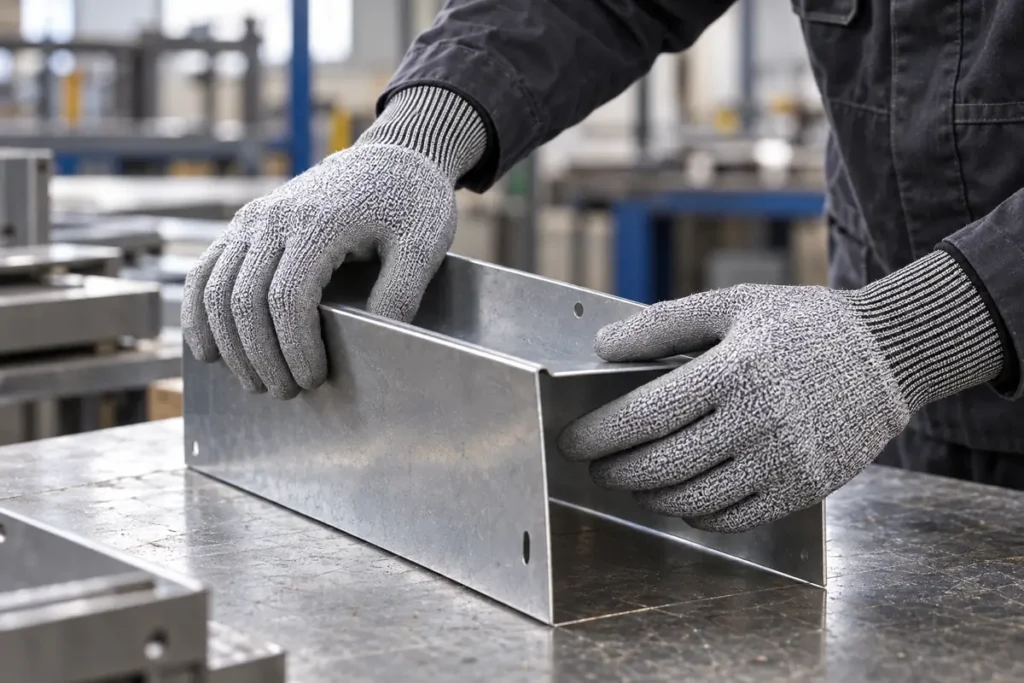
“Metal work” covers different exposures. You may lift flat panels, feed stamped parts, deburr edges, sort scrap, assemble components, or support a welding operation. Identify what contacts the palm, fingertips, and back of the hand, and whether the contact is brief, repeated, oily, hot, or close to machinery.
| Task | Hazards to assess | Glove properties to compare |
|---|---|---|
| Manual sheet loading and unloading | Sharp edges, panel weight, edge direction, repeated grip | Cut resistance, secure palm grip, fit and abrasion resistance |
| Handling stamped blanks | Fresh edges, burrs, narrow parts and high repetition | Cut protection in contact zones, dexterity, cuff fit and wear life |
| Deburring and finishing | Abrasive surfaces, sharp fragments, dust and tool contact | Abrasion and cut performance, grip, and compatibility with the tool procedure |
| Oily part handling | Reduced friction, contaminated surfaces and cleaning fluids | Grip tested in the actual oil condition, coating compatibility and change-out plan |
| Welding or hot-part support | Contact heat, sparks, spatter and sharp edges | Task-specific heat and flame performance, cuff coverage and cut protection |
| Press, roller or rotating machinery work | Crush, pinch and entanglement hazards | Follow machine-specific risk assessment and guarding rules before selecting gloves |
What to check in sheet metal handling gloves
Cut resistance must match the edge and the action
A cut rating is useful for comparing tested cut performance, but it does not predict every injury. Edge sharpness, force, direction, contact area, speed, and repeated exposure affect the real risk. Use your workplace assessment and applicable standards to set the required level; do not choose a level from the job title alone. Cut resistance also does not automatically establish puncture, impact, or heat protection.
Grip changes with oil, finish, and panel shape
A smooth, clean panel and an oily stamped part do not provide the same grip. Match the palm finish to the surface and evaluate it with representative parts under realistic conditions. A coating description such as PU or nitrile is not enough by itself to promise oil grip or chemical resistance. Confirm the material’s tested compatibility with the actual fluid and contact duration.
Fit and dexterity affect control
A loose fingertip can catch on an edge; a glove that is too tight can restrict movement. Check finger length, thumb movement, cuff security, and whether the worker can control the part and tools. More layers or reinforcement may improve durability in a contact zone but can reduce tactile feedback. Trial the candidate glove at the station before standardizing it.
Separate hot work from ordinary metal handling
Do not treat a cut-resistant glove as a welding glove. For welding and hot-part handling, verify the required heat performance, construction, cuff length, and resistance to sparks or spatter for the process. A glove intended for sheet handling may not be suitable for direct contact with hot stock.
When gloves may be unsafe around machinery
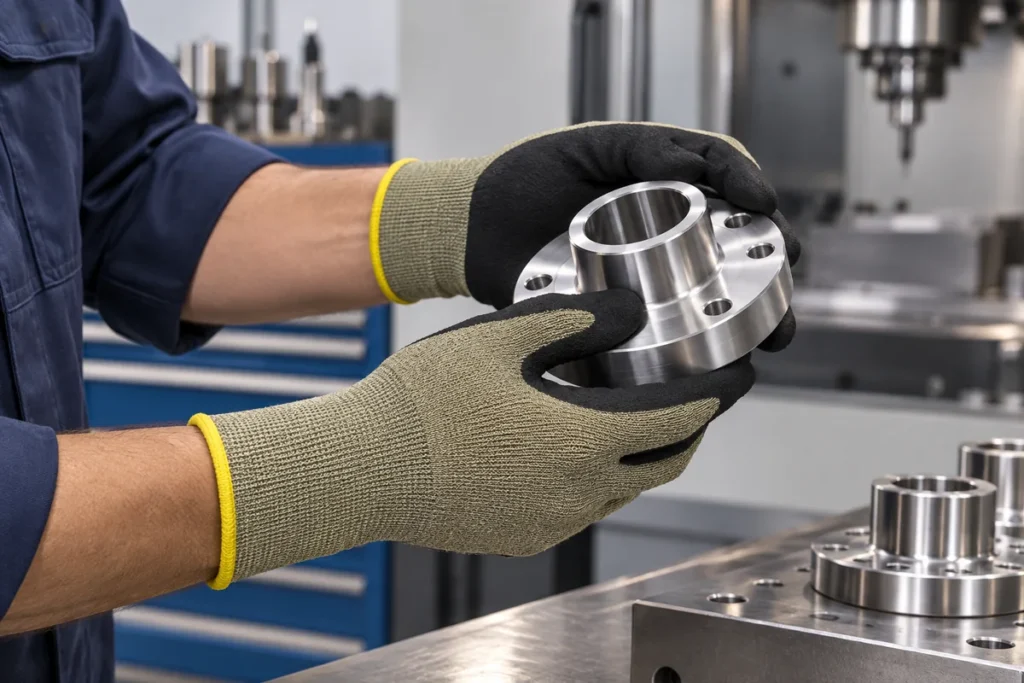
Cut protection is not the only consideration near a press, lathe, drill, roller or other moving equipment. A glove can be caught by rotating or moving parts. Follow the machine manufacturer’s instructions and your employer’s task-specific risk assessment. Never assume that a higher cut level makes glove use safe around an entanglement hazard. Where gloves are prohibited or increase risk, use the required guarding, tools and safe-work procedure instead.
A practical buying checklist for metal handling gloves
- List each operation separately: sheet loading, stamping, deburring, assembly, scrap handling or welding support.
- Describe the material: edge sharpness, burr condition, size, weight, finish, and oil or coolant exposure.
- Record the required cut, abrasion, heat, impact, or chemical properties separately, with the test method and supporting report for each claim.
- Confirm glove zones, liner, coating, cuff, size range and any reinforcement match the intended contact area.
- Trial samples with representative parts. Ask workers to assess grip, dexterity, comfort, durability, and task control.
- For bulk procurement, tie the approved sample, model code, specification, size ratio, packaging and inspection criteria to the same order revision.
- Set inspection, cleaning, replacement and damaged-glove rules before rollout.
What B2B buyers should ask a supplier?
If you are an importer, distributor, brand owner or safety manager, request the model-specific technical sheet and reports behind the claimed performance. Ask which glove areas were tested, whether the tested construction matches the sample, and how material, coating, color, or gauge changes are controlled in production. Request samples in the planned sizes and test them with the parts and fluids your customers actually handle. Do not compare supplier ratings without checking that the standard and test method are comparable.
Everpro options for metal work
Review Everpro’s steel and metal work glove range alongside the cut-resistant glove range. The A5 PU-coated glove and CUT-602 are examples to compare by task; confirm current product-page specifications and request the relevant test reports before selecting a model. For oily work, see Everpro’s oily-environment glove guide.
Frequently asked questions
What gloves are best for handling sheet metal?
Choose based on the edge, part weight, grip conditions, repetition, and required dexterity. Compare cut and abrasion performance, then trial fit and grip with representative panels. There is no single glove that suits every sheet metal task.
What cut level do I need for metal work?
There is no universal level for all metal work. Use a task-specific hazard assessment and the applicable standard to set the requirement. Consider edge condition, force, contact frequency and consequences, then verify the exact model’s test documentation.
Do cut-resistant gloves protect against punctures?
Not necessarily. Cut and puncture tests measure different properties. If pointed hazards such as burrs, wire ends or nails are present, assess puncture risk separately and request matching test evidence.
Can you wear gloves around a metal press or lathe?
It depends on the machine and task. Gloves can create an entanglement hazard around moving parts. Follow the equipment instructions, guarding requirements, and site risk assessment; do not rely on glove cut ratings to resolve this hazard.
Should oily steel be handled with the same gloves as dry sheet metal?
Not automatically. Oil can change grip and may affect coating suitability. Evaluate the glove with the actual fluid, contact duration, and part surface, and confirm compatibility from product-specific data.
Sources
- OSHA 29 CFR 1910.138: Hand Protection.
- ISEA: Hand protection standards resources.
- OSHA PPE hazard assessment and selection guidance.
This guide supports glove selection; it does not replace a workplace risk assessment, machine-safety procedure, or manufacturer instructions.