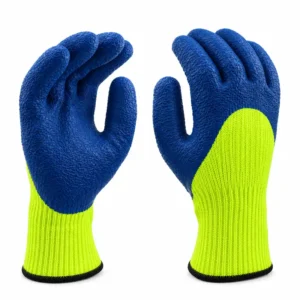
If you are asking what cut-resistant glove level you need, start with the object and the task rather than a job title. A warehouse worker opening cartons, a fabricator handling sheet metal, and a technician changing a slitter blade may all face sharp edges, but the force, frequency, and possible injury severity are different.
This guide helps you use ANSI/ISEA 105-2024 cut levels A1–A9 as part of a documented glove selection process. The rating is laboratory performance data, not a guarantee that a glove is cut-proof.
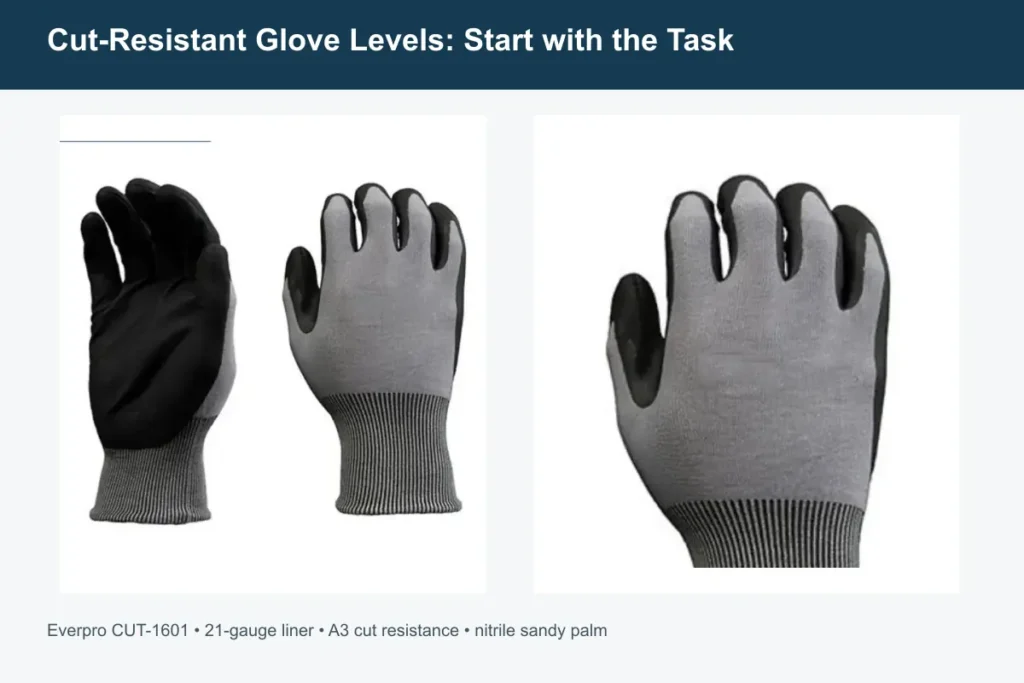
How to Choose the Right ANSI Cut Level for Your Task
Quick answer: match the level to the cut hazard
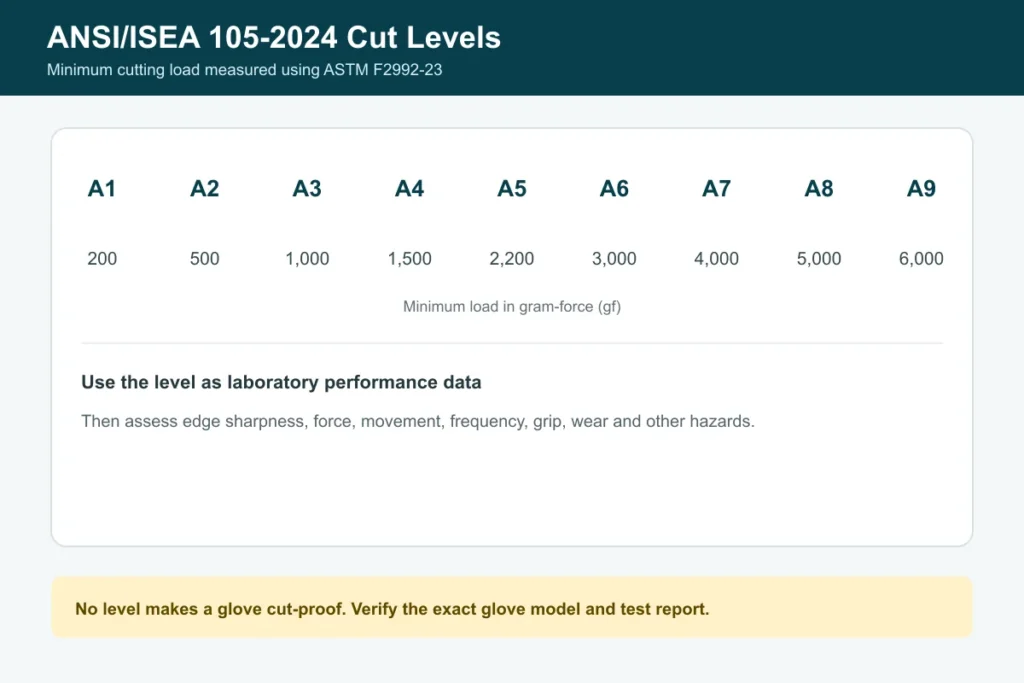
| ANSI cut level | Minimum cutting load | Useful starting point | Example tasks to assess |
|---|---|---|---|
| A1 | 200 gf | Light cut exposure | General handling and small parts with occasional light edges |
| A2 | 500 gf | Light to moderate exposure | Packaging, warehouse work and light assembly |
| A3 | 1,000 gf | Moderate exposure requiring dexterity | Automotive assembly, construction and light sheet-metal handling |
| A4 | 1,500 gf | Moderate cut hazards | HVAC, appliance work, glass and metal fabrication |
| A5 | 2,200 gf | Moderate to high exposure | Regular handling of sharper metal, glass or cutting tools |
| A6 | 3,000 gf | High cut hazards | Metal stamping, recycling and heavy fabrication |
| A7 | 4,000 gf | High exposure with greater force | Sharp stampings, glass processing and blade-adjacent work |
| A8 | 5,000 gf | Very high cut exposure | Severe sharp-edge handling identified by a task assessment |
| A9 | 6,000 gf | Highest classification in this scale | Extreme cut hazards where the risk assessment supports maximum test performance |
These examples are screening guidance. You should not assign a level from the industry name alone. Observe the task, review incident history, and test the complete glove in controlled working conditions.
What ANSI/ISEA 105-2024 measures
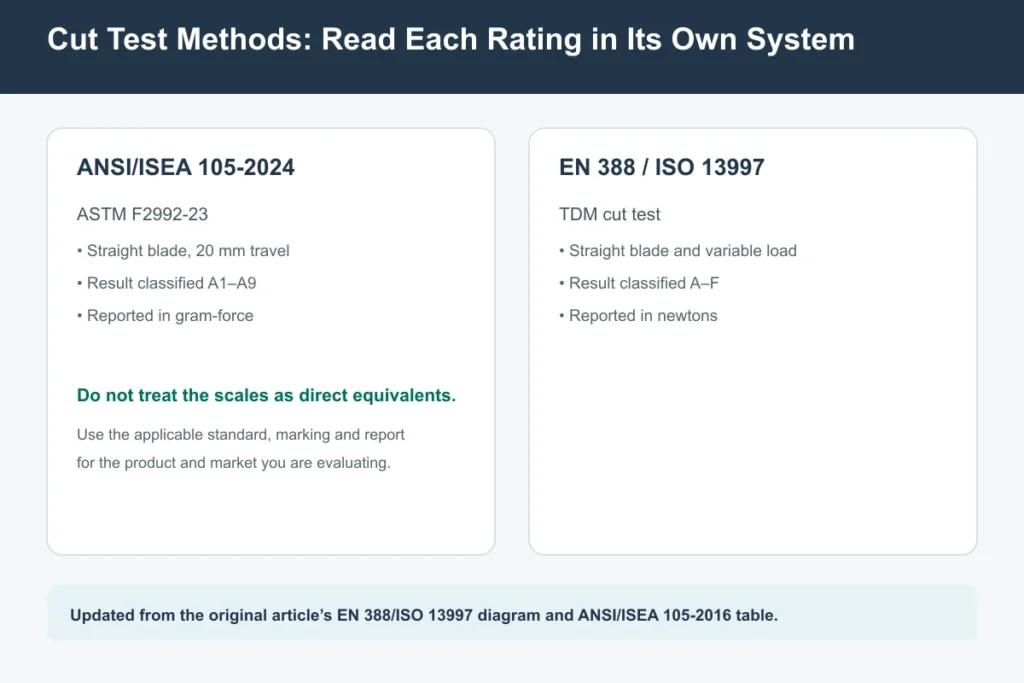
The current ANSI/ISEA 105-2024 classification uses ASTM F2992-23 for cut testing. A blade travels 20 mm across the glove material, and the result is the force in grams-force needed to cut through it. Higher A-levels require a higher cutting load.
The 2024 edition introduced standardised product labelling for abrasion, cut and puncture classifications. When you buy a glove, check the complete label and verify the supporting report for the exact model, liner, gauge, coating and size range.
How to choose your cut-resistant glove level
1. Identify the sharp object
Record whether workers handle cardboard, plastic strapping, stamped metal, sheet edges, glass, blades, wire, or broken parts. Describe the edge condition: smooth, burred, freshly cut, serrated, or broken.
2. Estimate force and movement
A stationary edge touching the hand is different from a blade moving across the glove under pressure. Consider the worker’s push or pull force, the weight of the part, the speed of movement, and whether a slip could drive the hand into an edge.
3. Consider exposure frequency
Occasional contact and hundreds of handling cycles per shift create different durability requirements. Frequent abrasion can damage yarn and coating before a cut event occurs, so examine abrasion performance and replacement triggers as well as cut level.
4. Assess the likely consequence
Consider the depth and location of a possible injury, the proximity to tendons or arteries, and whether the task could cause a severe laceration. Use engineering controls and guarded tools first; PPE addresses the remaining risk.
5. Add other hazards
Cut resistance does not automatically provide puncture, needlestick, impact, chemical, or heat protection. Specify those properties separately. If back-of-hand impact is present, review our ANSI/ISEA 138 impact glove guide.
Why the highest level is not always the right choice
An A9 glove may add yarn density, reinforcement, thickness, weight, or stiffness that the task does not require. If a glove reduces grip or fingertip control, workers may apply more force, remove it, or struggle with tools. Your objective is the required protection with enough dexterity and grip to perform the task safely.
Modern fibres and fine-gauge knitting can improve comfort at higher levels, but you still need a wearer trial. Compare hand fatigue, pressure points, sweat, donning, tool control, and performance after repeated flexing.
Cut level is only one part of glove construction
Liner material and gauge
HPPE, aramid, steel or glass fibres and engineered blends can produce different combinations of protection, weight and flexibility. Gauge describes knitting density; it does not prove a cut level by itself.
Palm coating
PU can support dry precision handling, while foam, microfoam or sandy nitrile can improve grip in dry or oily conditions depending on the formulation. Coating coverage also affects breathability and liquid contact. Compare Everpro’s nitrile, latex, PU, and PVC coating guide.
Coverage and reinforced areas
Confirm whether protection covers the palm, back of hand, fingertips, thumb crotch, and wrist area exposed by the task. A reinforced area helps only when it aligns with the contact point.
Fit and sizing
A loose glove can snag and reduce control; a tight glove can increase fatigue and stress seams. Test every required size rather than approving one sample for the entire workforce.
ANSI A-levels and EN 388 cut letters are not interchangeable
ANSI/ISEA 105 reports cut resistance as A1–A9 in grams-force. EN 388:2016+A1:2018 reports ISO 13997 TDM cut performance as letters A–F in newtons, alongside abrasion, Coup cut, tear, puncture, and optional impact results. Both systems use controlled cut testing, but their classifications and markings differ.
Do not convert one marking into the other using a simple chart. For European purchasing, read our EN 388 glove ratings guide. For North American labelling, use our ANSI/ISEA 105-2024 guide.
How to verify a supplier’s cut claim
- Match the model code on the glove, packaging, datasheet, and test report.
- Confirm the standard edition and test method.
- Check whether the report covers the supplied liner, coating, and construction.
- Review cut, abrasion, and puncture ratings separately.
- Check batch-control and change-management procedures for yarn or coating changes.
- Request production samples in all required sizes.
- Run a controlled field trial and document replacement criteria.
Practical level-selection examples
Packaging and warehousing
For cartons, strapping and light sharp edges, A2 or A3 may be a starting point, provided your assessment confirms the force and frequency. Prioritise grip, breathability and dexterity for repeated handling.
Sheet metal and automotive assembly
A3 to A5 may be considered for light and moderate sheet edges, while sharper stampings or heavier force may justify a higher level. Check abrasion, oily grip, and thumb-crotch wear.
Glass and recycling
Broken glass, hidden sharps, and unpredictable edges can require higher cut protection and sometimes puncture or forearm protection. Do not use cut level alone to approve the glove.
Blade change and severe sharp-edge tasks
A6 to A9 may be appropriate after engineering controls and lockout procedures are applied. Evaluate the exact blade, likely movement, and the need for sleeves or additional guarding.
Frequently asked questions
Is A9 cut-proof?
No. A9 is the highest ANSI cut classification, but no glove is cut-proof. Sharpness, force, movement, wear and exposed areas still affect injury risk.
Is A3 enough for sheet metal?
It may suit some light sheet-metal tasks, but burrs, thickness, handling force and frequency vary. Perform a task assessment and controlled trial before approval.
Does a higher cut level mean better puncture protection?
No. Cut and puncture are separate properties. Needlestick resistance is also different from industrial probe puncture testing.
When should cut-resistant gloves be replaced?
Replace them when you see cuts, broken yarn, worn coating, holes, contamination, loss of grip, or deformation, and according to your documented inspection schedule.
Can I compare ANSI A4 with EN 388 level D?
Not as direct equivalents. Use the result and marking within the applicable test system and market requirement.
Build a purchase specification from the task
State the sharp object, handling force, frequency, required ANSI or EN rating, coating, cuff, sizes, grip condition, other hazards, marking, report, and sample-approval requirements. View Everpro’s cut-resistant glove range, including the 21-gauge A3 nitrile sandy glove, or contact Everpro Gloves with your task details.