


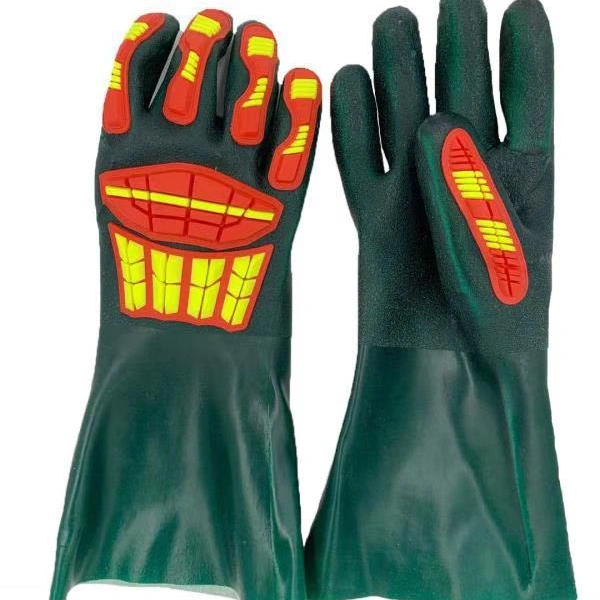

Hand safety protection is always the top priority in industrial production, building construction, logistics, transportation, and many other fields. As a key personal protective equipment, the performance and quality of impact-resistant gloves are directly related to the safety and health of staff. With the continuous progress of science and technology, the field of impact hand gloves has ushered in a brand new change and development.
First, the current situation and demand growth of the impact hand gloves market.
The global protective gloves market is showing a rapid growth trend. According to a report published by Reports and Data, a market research organisation, the global protective gloves market has reached approximately $11 billion in 2023 and is expected to exceed $16 billion in 2027, with a compound annual growth rate (CAGR) of 6.4%. This growth is mainly driven by factors such as rising demand for industrial safety, increased health awareness in the wake of epidemics, and technological innovation and product diversification.
In China, as one of the world’s largest markets for the production and consumption of protective gloves, the demand for safety in the manufacturing industry is extremely strong. Especially in the automotive, steel, chemical and other fields, the demand for protective gloves is extremely large. With the continuous reinforcement of the “Work Safety Law” and related regulations, companies are increasingly strict on the safety and protection of employees. Meanwhile, the medical industry is experiencing a surge in demand. With the rapid development of the medical industry and the ageing of the population, the demand for protective gloves continues to grow, especially during epidemics, when protective gloves become a must-have for hospitals, clinics, and other healthcare organisations. In addition, the demand for protective gloves in the field of family and personal use is also gradually increasing. With the improvement of the living standard of the population, the demand for protective gloves for daily cleaning, gardening and maintenance activities in the family is rising.

Second, impact hand gloves technology innovation: from “passive protection” to “active cushioning”.
Material innovation:
New materials such as super wear-resistant synthetic materials, polymers with stronger protective properties are widely used in the manufacture of impact hand gloves. This not only improves the protective performance of the gloves but also enhances the comfort of wearing them.
The development of “anti-vibration and anti-impact beads” technology, i.e. the implantation of high-density polymer microspheres in natural latex to form a unique “sponge-like porous structure”. This structure can break down the impact force into tiny vibration waves during an impact, increasing cut and abrasion resistance by 40% while keeping the overall weight of the glove 25% lighter. Laboratory tests have shown that this technology can reduce the exposure to hand vibration (AHV) to less than 1/3 of the international standard ISO 5349-1.
Preparation process innovation:
With the development of technology, the preparation process of impact hand gloves has been optimised. Firstly, the natural latex is pre-cured using a specific vulcanisation system to obtain pre-cured latex, which needs to meet certain Q value, mechanical stability, viscosity, constant tensile stress, tensile strength and elongation at break and other process requirements.
Then, surfactants (such as alkylphenol polyoxyethylene ether), foaming agents (such as phenylsulfonylhydrazine) and thickeners (such as bonded acrylates or dry rosin) are added to the pre-cured latex in a specific order, and mixed homogeneously by stirring or vibration, to obtain the back of the hand dotting bead adhesive or the palm surface dotting bead adhesive. In the subsequent bead-dotting, drying, foaming, vulcanisation and other processes, the synergistic effect of the raw materials ultimately results in excellent cushioning performance and protective properties of the impact gloves.
The impact resistant rubber layer formed by chemical foaming contains a dense protective film and a gas sealed inside the layer by the protective film, so that the gas will not escape when subjected to impact, which greatly enhances the cushioning performance, improves the impact protection function, causes less harm to human hands, and is more durable.
Innovation of a modularised protection system:
Aiming at different working environments and the differentiated needs of work types, modern anti-impact gloves have formed a standardised modular system. For example, in the automotive manufacturing scenario, the diamond wire composite material with an anti-cutting grade of EN388 Level 5, combined with conductive fibres with ESD (electrostatic dissipation) function, not only meets the safety standards of the press shop but also ensures the precision of electronic component assembly. This design thinking of “protection performance + function expansion” is reshaping the product definition of the industry.

Third, Changes in Market Demand and Awakening of Safety Awareness
3.1 Compulsory Driving of Occupational Health Regulations
With the implementation of amendments to the Work Safety Law in various countries, it has become a mandatory requirement for companies to equip their employees with protective gloves that comply with the EN ISO 21420 standard. Taking China’s manufacturing industry as an example, the automotive industry alone has a new compliance demand of over 20 million pairs per year. This policy dividend directly pushes the crash gloves market to grow at a CAGR of more than 12%, and the market size is expected to reach $8.5 billion in 2027.
3.2 Ecological integration of smart wearable devices
When impact hand gloves meet industrial Iot, safety protection enters the 2.0 era. Smart gloves with integrated pressure sensors can monitor the hand fatigue index in real time and upload the data to the enterprise safety management system through LoRa wireless communication technology. This “protection + data” solution reduces the accident rate by 35% and helps enterprises pass the ISO 45001 occupational health and safety management system certification, which is a smart impact hand gloves development trend in the future development of society.
3.3 Environmental appeal of sustainable consumption
Under the influence of the ESG investment concept, the application of bio-based materials has become a new windfall for the industry. Impact hand gloves using corn starch-based polylactic acid fibres not only achieve natural degradation in 180 days but also reduce carbon emissions in their production process by 78% compared to traditional petroleum-based materials. This green innovation is helping the company to win the qualification of large supermarkets and international suppliers, and is gradually promoting its development.

IV. Fields of application
Industrial field:
In high-risk industries such as construction, chemical industry, machinery manufacturing and so on, impact hand gloves have become essential safety protection equipment. For example, in the construction site, workers the operation of heavy machinery, handle construction materials, and their hands are easy to be impacted and injured. Wearing impact hand gloves can effectively reduce the impact and vibration of the equipment on the hands, increase non-slip strength, improve work efficiency and protect the safety of workers.
Logistics and Transportation:
Under the extreme environmental challenges of cold chain logistics, traditional rubber gloves become brittle in 30 minutes. The new silicone rubber composite material is obtained through the molecular chain modification technology, so that the gloves in the -40 ℃ to 120 ℃ interval maintain stable performance. It ensures the safety of hand protection for logistics personnel in the process of handling goods, operating forklifts and so on. Wear-resistant, non-slip, shockproof, and other functions of impact hand gloves can effectively reduce the risk of hand injuries and improve work efficiency. The measured data of an international supermarket chain shows that wearing customised impact hand gloves makes the accident rate of hand impact injuries of the handlers drop by 30%, and the efficiency of single loading and unloading increases by 15%.

Fourth, the future trend: the construction of an intelligent protection ecosystem
With the penetration of 5G and AI technology, impact hand gloves are evolving from a single protective device to a perceptive “nerve endings”. By implanting a flexible display on the back of the gloves, workers can obtain real-time information such as equipment parameters and operation guidelines; the AI chip built into the gloves can predict potential safety risks and issue warnings based on the trajectory of hand movements. This “protection – perception – decision-making” closed-loop system will enable industrial safety to enter the “zero accident” era.
In this era of challenges and opportunities, hand safety and protection should not be neglected.Evepro Safety impact hand gloves provide solid protection for workers in all walks of life with their excellent performance and reliable quality.
Choosing our impact hand gloves is choosing safety, quality and peace of mind. Let’s join hands together to promote the development of the safety glove industry and protect our family, friends and every frontline worker.
